Author: Andrew Becraft

Author, poet, and technologist. Founder and Editor-in-Chief of The Brothers Brick.

打ち寄せる古里の波

You can also read the earlier English version of this poem.

その瞬間、砂に立ちながら気付いたのは
     足下のがらくたが何であること
          流木にもつれ合っている
     羽毛でまだらの
          昆布にまつわりつかれた物

蕎麦屋の壁、酒屋の屋根
     数え切れない住宅から
          黄色い絶縁体の塊

台所と居間から
     浴室と寝室から
醤油がまだ中に流れる瓶
     紅茶と麦茶と歯ブラシ
          テレビ

高潮がうちよせた曲線を歩む我
     割れたサンダルをまたぎ
          長靴の靴底を渡る

この物一つ一つは意味があると解った

ただのゴミではない

だれかが捨てた物でもない

あの晴れた金曜日の午後
     緊急警報が放送された一瞬
          おじいちゃんは
     テレビで何を見ていたのか

床が震え、
     戸棚から料理の材料が
          霰のように降り
     近所の人々が外で叫び出したとたん
          おばあちゃんは
     どのような食事を準備していたのだろう

前は避難勧告が鳴り響き
     後は海のとどろき
          走れるところも無く
     おばあちゃんは階段で靴を無くしたのだろう

一万キロ離れた我はその夜
     母国が流されるのを観た
          故郷の土で黒く染められた波
               木製の風浪

古里へ戻ることは出来ない

この砂浜でそれは分かった
     
しかしながら、
     黒く染められた波に乗り
          木製の風浪に運ばれ
     古里は我の足下に流されていた。

Visiting the Space Shuttle FFT & touring a B-17 at the Museum of Flight

A couple weeks ago, I watched NASA’s Super Guppy flying in the crew compartment section of the Space Shuttle Full Fuselage Trainer (FFT). Today, I checked it out while it was being reassembled at the Museum of Flight here in Seattle.

Space Shuttle trainer assembly (1)

Yes, it’s made of wood, but every shuttle astronaut was trained in the FFT, and the last crew even signed their names under the nose — it’s an important part of NASA history. One of the wonderful things about Seattle getting the FFT rather than one of the actual shuttles is that visitors to the museum will be able to go through it, as we can do today aboard the first jet-powered Air Force One, a Concorde, and one of the last B-17 bombers still in flying condition.

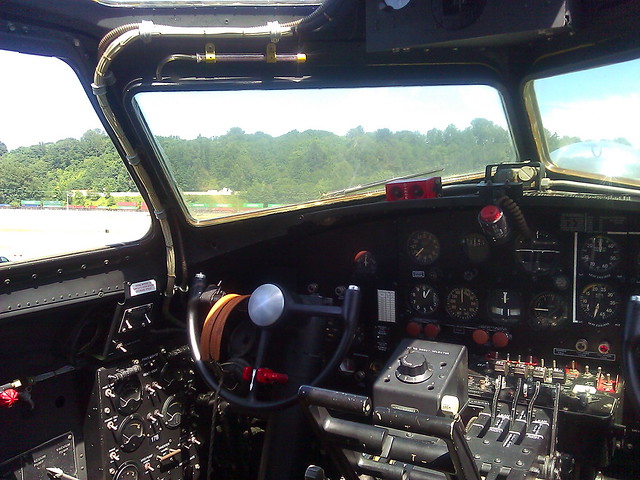
As much as I’m anticipating a tour of the FFT, I was most inspired today by a walk-through — more of a crawl-through, really — of that Boeing B-17 Flying Fortress. The “Boeing Bee” is one of only a handful of B-17’s still capable of taking to the skies. The bomber was manufactured just up the road from the Museum of Flight, and our docent was a retired Boeing engineer, able to rattle off both technical details and war stories with equal panache.

B-17 cockpit (1)

After squeezing around the ball turret, through the radio room, across the bomb bay, and into the cockpit, it wasn’t difficult to imagine how hellish it must have been for the ten-man crew, flying into German flak and fighters. But with thousands of pounds of bombs and eleven .50-caliber machine guns sprouting from just about every surface, the B-17 dealt death to the world below in equal measure.

Standing there in the July sun outside the Museum of Flight, I thought back to a quote I’d just read inside, from James Smith McDonnell, founder of the McDonnell Aircraft Corporation — builder of both fighter planes like the F-4 Phantom II and space capsules for the Mercury and Gemini programs:

“The creative conquest of space will serve as a wonderful substitute for war.”

Perhaps there’ll be a day when we pour as much technology and passion into the conquest of space as we do into conquering each other.

Why I’m proud to be an American, and why that’s okay

I celebrated Canada Day earlier this week by embracing my Canadian heritage, but today is the 4th of July, Independence Day. Even though my family has a long history in America, I’ve struggled to feel a sense of belonging as an American all my life — something I’ve begun exploring in My Fellow Americans.

James Becraft and McCoy Logging Crew
My great-great-grandfather James Samuel Becraft with his logging crew in Skagit County, Washington in the 1880s or 1890s.

Too often, one person’s patriotism is simply militant nationalism experienced by another. What makes American patriotism such an important value, while Russian or Chinese nationalism remains something that so many Americans fear? Isn’t the latter simply patriotism — something so often touted as an inherent good? I would argue that patriotism and nationalism are two sides of the same coin, and both sentiments to be avoided if we don’t want to doom humanity to a future full of conflict. It’s hard for me to be proud of my country in relation to all others — especially in light of our nation’s darker moments.

Half-jokingly at first, I started a list earlier this week of “Things that make me proud to be an American,” beginning with corn dogs and baseball — both classic American inventions in that they (arguably) improve on the original ideas brought here by immigrants. As I added to the list, it became clear that there really are things that I’m proud of as an American. (I tweeted them all today, likely annoying a fair number of my few followers.)

The people of the United States have accomplished great things in our history, and we as a people can justly take pride in these achievements. People like Benjamin Franklin, Martin Luther King, Jr., Nikola Tesla, and Henry David Thoreau personify what it means to be American, and each has contributed enormously to the philosophy, science, and culture of our country. Each of these people has moved America forward.

Human beings are an inventive species. Throw enough of us on a continent and we’re sure to come up with some good ideas. The telephone and telegraph, combined with computers like ENIAC, programming languages like FORTRAN, and markup languages like GML, all set the stage for the Internet and the World Wide Web. Poets like Walt Whitman, Robert Lowell, and Galway Kinnell capture the American spirit like no others — from celebration to dissent. NASA and the US Space Program bring us closer to a life beyond this planet we were born on.

None of these accomplishments — whether scientific, artistic, technological, philosophical, or literary — diminishes what other nations have accomplished; all of them contribute not just to this nation’s future, but to the future of humanity itself.

Yes, I’m proud proud to be American, but I’m also proud to have been born in Japan, proud to be one quarter Canadian, proud of my Indian / First Nations heritage, and proud of my immigrant ancestors who arrived from England (1620 in Plymouth), France (1635 in Virginia), Holland (1652 in New Holland), Sweden (1654 in New Sweden), Ireland (1689 in Delaware), Germany (1741 in Philadelphia), and everywhere else.

This is the kind of pride in America that my foreign-born, cynical, liberal self can feel without guilt. Migration and innovation are inherent to the human experience, going all the way back to our first ancestors in Africa. Thus, my pride in American achievement and my own immigrant ancestry is simply pride in knowing that I’m both a result and an example of an innately human story.

Neolithic tools - 'Ain GhazalMost of all, I’m proud to be part of the human race — a species born in Africa, a people who invented language, music, art, agriculture, literature, and the science that will someday take us to the stars. For me, America is just one stop on the human road from Africa to the stars. I’m proud to have taken a few small steps with my fellow humans along that journey.

Celebrating 1/4 Canada Day

Today, one quarter of me celebrates Canada Day.

In 1783, the First American Civil War ended in the defeat of the Loyalist forces. Many chose to move north, uprooting their families long-established in New York, Pennsylvania, and New England. Among them were about one quarter of my ancestors — Jacob Segee (an officer in the Loyal American Regiment), Peter Snyder (born in Philadelphia to German immigrants), and many others.

My Loyalist ancestors founded Fredericton, New Brunswick. As with nearly everywhere on the continent, though, people had been living in that part of the world for decades, centuries, and millennia. French and Scottish fur trappers had also been settling there, marrying Algonquian-speaking First Nations women. One man named MacPherson married an Indian woman some time before the middle of the 19th Century, creating a Métis family. On the 1851 Census of Canada, Samuel Duncan MacPherson — my great-grandmother’s great-great-grandfather — and his family are listed as “Native” (even though his wife Eliza is actually a Segee descended from New Yorkers).

Fast forward to the early 20th Century, and my great grandparents William Clark and Velma MacPherson have arrived in Maine. I’m fortunate to have known six of my eight great-grandparents. I visited Great Grampy and Grammie at their home in Massachusetts in the 70’s, and several times after they’d continued their southward journey even farther, ultimately settling in Florida. According to the 1940 US Census, Grampy worked as a telegraph operator for a railroad company in Bangor, Maine. All I remember today is that Grampy liked Cadillacs and all-you-can-eat buffets and that Grammie carefully covered their living room furniture in plastic.

But today, I know so much more about these Canadian transplants and their families. I now know that I’m descended from both sides of the American Revolution, as well as both peoples who settled North America (the more recent within the last several hundred years, the other millennia earlier).

Knowing that, I can embrace my Canadian and First Nations heritage alongside the American heritage I’ll be celebrating in three days.