Author: Andrew Becraft

Author, poet, and technologist. Founder and Editor-in-Chief of The Brothers Brick.

Chauvet in 3D – Cave of Forgotten Dreams

My sense of awe and wonder is most often sparked by a newfound understanding of my place in the universe, a feeling Michael Shermer calls “deep and sacred science.” I’ve felt it listening to “The Messiah” in Westminster Abbey next to Handel’s tomb, unearthing the hearth of a 3,200-year-old house, or climbing hundreds of steps through mist-soaked cedars to a neglected Shinto shrine.

For me, the sense is strongest when I feel a connection to my fellow humans, both those with whom I share the planet today and all those who came before. It’s one reason I’m so fascinated by archaeology — the deeper the past, the deeper my awe and wonder.

Lions painting, Chauvet Cave (museum replica)

The Chauvet cave in southeast France was discovered in 1994, and contains the world’s oldest examples of cave art. Artists painted and engraved horses, aurochs, rhinos, mammoths, lions, leopards, and many other Ice Age animals on the cave walls 32,000-30,000 years ago (in the Aurignacian) and again 27,000-26,000 years ago (Gravettian). Just as in Lascaux, the artists used the natural contours of the cave to accentuate their artwork — the jaw muscles of a horse, the humped shoulder of a bison.

You can’t see these shapes in photographs, and unlike Lascaux there is (as yet) no full-scale modern reproduction to satisfy those of us who won’t ever step through that locked door and enter this ancient cathedral.

This is where Werner Herzog‘s new documentary “Cave of Forgotten Dreams” proves invaluable.

Herzog’s film captures the pristine cave art like no photograph or even 2D movie can. Herzog also includes touching moments of modern humanity, like the experimental archaeologist who plays “The Star Spangled Banner” on a reproduction Ice Age flute, his colleague who dreamed of lions after spending five days in the cave, and the master perfumer who crawls through the brush sniffing for the scent of undiscovered caves.

My only criticism is reserved for the last two minutes of the film, during which Herzog narrates a well-meaning “postscript” that attempts to connect modernity with antiquity via an analogy featuring albino alligators warmed by nuclear power plant effluvium. (No, I didn’t get it either.) After the final cave sequence, it would have been a postscript best left unread.

But when the filmmaker lets light, dark, the cave, and the artists themselves work their ancient magic, the experience is positively numinous.
Naps

I didn’t take naps. I don’t think I’d ever taken naps.

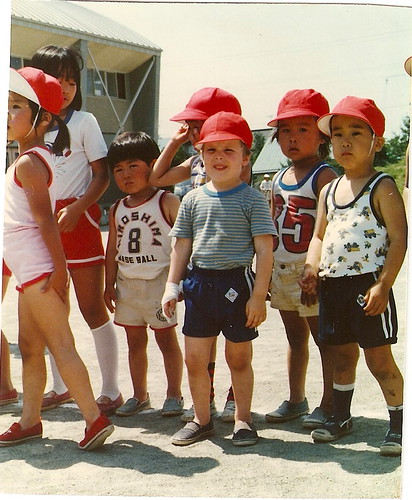
Father had church business with church elders next door, and he left me to play with the kindergarteners. At first, they stared at me, even though I wore the same clothes they all wore — blue shorts, white shirt, and round red hat.

Sapporo, 1978

The oldest boy called me a gaijin and then laughed.

“I was born in Tokyo,” I corrected him, “I’m a Child of Edo, you Son of the Soil.” Some of the girls laughed.

I played on the swing. The toes of all the other children had scooped the dry sand from under the seats, leaving furrows beneath my feet. At the top of each arc, I could see our blue Subaru over the concrete wall, parked in the church driveway. I played hopscotch with the girls who were nice earlier. I let them win.

A bell rang and we all went inside to sing “Twinkle Twinkle Little Star.” When we sang “The Elephant Song,” I waved my arm from my face just like everyone else. The others were learning to count, but I already knew all ten of them so I was bored.

A lady in glasses and a green dress brought rice balls wrapped in seaweed and we each took one. I loved the saltiness of the black seaweed and the tang of the pickled plum in the center of the rice. The taste reminded me of staying over at Aunt Kiwako’s.

The teacher and the lady in green took mats from a closet and laid them on the floor. The others lay down quietly, some on their sides, some on their backs, some on their stomachs with an arm cradling their face. I told them I didn’t take naps but they didn’t care. They told me to lie down quietly and close my eyes.

I watched the red and green swirls behind my eyelids. I practiced counting to ten. I thought about the day before, when mother and I went to the park to meet father after work. I jumped over ditches and didn’t fall in. My favorite slide snaked down the hill, and I raced mother, me sliding in my corduroys, she running in her plaid skirt. I always won. Father came swinging his black briefcase.

When I woke up, we were on the highway home. I opened my eyes and pretended I hadn’t been sleeping. Some old ladies were planting shoots of rice in a field that we passed. They were probably singing.

Father said, “Did you sleep well? You must have had a lot of fun with all your new friends.”

“I wasn’t sleeping,” I said. “I don’t take naps. And they weren’t my friends.”

Rain began to streak the windows. Father flicked a knob and the windshield wipers started playing sumo. The one on the left always won. I turned to watch the power lines dip down, and then up, and then down again.

The Humans Who Went Extinct by Clive Finlayson

This past year, my reading has alternated between classic science fiction and non-fiction archaeology or anthropology — two very different literary forms that encapsulate opposite ends of our shared and potential experience. Along the way, I’ve discovered three books that truly span the breadth of human history, from past, present, to future. No three books alone could represent millions of years completely, of course, but these books do provide a concise overview, and though written by three different authors, they complement each other to form an overarching story of human existence.

I’ll be posting separate discussions of each book, with a wrap-up of the three after I’m done with them individually. Let’s begin with The Humans Who Went Extinct: Why Neanderthals Died Out and We Survived by evolutionary ecologist Clive Finlayson.

In The Humans Who Went Extinct, Finlayson supplements his direct experience excavating the last stronghold of the Neanderthals at Gorham’s Cave in Gibraltar with multi-disciplinary research for the causes of human extinction. But humans aren’t extinct, right? Wrong.

Some of our close human cousins didn’t quite make it. Homo erectus flourished in Asia for hundreds of thousands of years while Homo neanderthalensis did the same in Europe, long before our own ancestors ever stepped foot outside Africa. Both species made tools similar to our direct ancestors, and DNA evidence indicates that Neanderthals were most likely capable of speech. The received wisdom of contemporary paleoanthropology and archaeology takes the stance that anatomically and behaviorally modern humans (Finlayson conveniently shortens this to the straightforward “Ancestors”) displaced our cousins when we left Africa and spread throughout the Eurasian continent.

Finlayson examines both the material culture of the Neanderthals and the ecological conditions across the past 125,000 years to argue that their environment degraded repeatedly — from dense forests that supported the ambush hunting style of the Neanderthals (as evidenced by their weapons) to steppe-savanna landscapes where herds or individual prey animals were few and far between and which required a fundamentally different set of technologies and behaviors to succeed.

Neanderthals were not able to adapt to the challenges and opportunities presented by the new, more open landscape. (And with one rare but crucial exception in Central Asia, neither were Ancestors.) The range of humans expanded and contracted with the ebb and flow of forests for thousands of years, placing populations under pressure to the point of local extinctions. Finlayson argues that Neanderthals (and Homo erectus) were pushed to the brink of extinction by the contraction of their traditional environments until the small pockets of survivors were no longer viable populations, cut off from each other and susceptible to one bad winter or outbreak of disease. The last Homo erectus lived on Java until as recently as 50,000 years ago, while Homo neanderthalensis held out at Gibraltar until 24,000 years ago.

Meanwhile, Finlayson suggests that Ancestors on the fringes of our traditional comfort zones were being forced to adapt or die. Most died. He traces the origin of the Gravettian culture to an adaptation by a founder population in Central Asia before about 30,000 years ago. The specific adaptations that enabled these people to survive were the centralized villages that served as home base — and most importantly information exchanges and surplus stockpiles — for the hunters, along with new technologies such as lighter, more portable stone tools that could be adapted to new projectile weapons necessary on the open plains. These people spread west to Europe and northeast across the Bering land bridge to the Americas.

Throughout The Humans Who Went Extinct, Finlayson illustrates how the tension between innovation by fringe populations and conservatism among otherwise stable core populations leads to only two possible results when their environments change. In most cases, environmental challenges have been too great and the vast majority of human diversity has not survived. But when the right opportunities happen to be present, the innovators who take advantage of challenges presented by their environment survive while conservatives who fail to do so die.

The impact of ecology on human success or failure is a theme that will appear again in the next two books we examine.