Category: Science

One small step

NASA and space exploration have always been one of the things that makes me proud to be an American. Today in 1969, humans stepped foot on another celestial body for the first time.

Apollo 11 bootprint

Neil Armstrong and Buzz Aldrin’s moon landing remains one of the singular achievements of the human race. My hope remains that I will live to see our species send representatives to the Moon again, and then on to Mars.

Visiting the Space Shuttle FFT & touring a B-17 at the Museum of Flight

A couple weeks ago, I watched NASA’s Super Guppy flying in the crew compartment section of the Space Shuttle Full Fuselage Trainer (FFT). Today, I checked it out while it was being reassembled at the Museum of Flight here in Seattle.

Space Shuttle trainer assembly (1)

Yes, it’s made of wood, but every shuttle astronaut was trained in the FFT, and the last crew even signed their names under the nose — it’s an important part of NASA history. One of the wonderful things about Seattle getting the FFT rather than one of the actual shuttles is that visitors to the museum will be able to go through it, as we can do today aboard the first jet-powered Air Force One, a Concorde, and one of the last B-17 bombers still in flying condition.

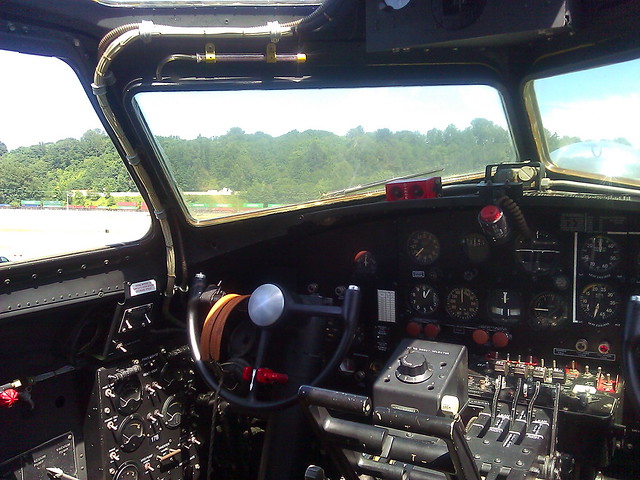
As much as I’m anticipating a tour of the FFT, I was most inspired today by a walk-through — more of a crawl-through, really — of that Boeing B-17 Flying Fortress. The “Boeing Bee” is one of only a handful of B-17’s still capable of taking to the skies. The bomber was manufactured just up the road from the Museum of Flight, and our docent was a retired Boeing engineer, able to rattle off both technical details and war stories with equal panache.
B-17 cockpit (1)

After squeezing around the ball turret, through the radio room, across the bomb bay, and into the cockpit, it wasn’t difficult to imagine how hellish it must have been for the ten-man crew, flying into German flak and fighters. But with thousands of pounds of bombs and eleven .50-caliber machine guns sprouting from just about every surface, the B-17 dealt death to the world below in equal measure.

Standing there in the July sun outside the Museum of Flight, I thought back to a quote I’d just read inside, from James Smith McDonnell, founder of the McDonnell Aircraft Corporation — builder of both fighter planes like the F-4 Phantom II and space capsules for the Mercury and Gemini programs:

“The creative conquest of space will serve as a wonderful substitute for war.”

Perhaps there’ll be a day when we pour as much technology and passion into the conquest of space as we do into conquering each other.

NASA Super Guppy brings Shuttle trainer to Seattle

We hustled out of the house this morning to Kite Hill at Magnuson Park in the hopes that we could catch a glimpse of NASA’s Super Guppy transport plane as it flew into Boeing Field, loaded with the nose and crew compartment of the Space Shuttle Full Fuselage Trainer (FFT). Though I’m disappointed that Seattle’s Museum of Flight won’t be getting one of the real shuttles, the wooden FFT mockup was used to train every shuttle astronaut, and the general public will be allowed inside it (unlike the real deals in the Smithsonian, Intrepid Museum in New York, and elsewhere).

After craning our necks at every sea plane overhead, the Guppy and its Learjet chase plane quietly flew north on the other side of Lake Washington:

NASA Super Guppy & chase plane over Lake Washington

If you squint just right, you can see the Super Guppy dwarfing its Learjet chase plane. This camera phone photo doesn’t really do the experience justice. With such a long history of aviation, the Seattle sky is full of interesting planes — I’ve seen a B-17 Flying Fortress and a B-25 Mitchell (twice) fly over in the last three weeks. But the Super Guppy carrying Space Shuttle history was something unique. Everyone at the park looked up, shouting for others to look and wondering (if they hadn’t read the paper this morning) what such an odd airplane could be.

Beneath the Guppy’s flight path, the experience was even more awe-inspiring. My friend Mark commented on the photo above, “That’s it going right over my house. It was an incredible thing. Windows rattled, dogs barked. Flying so low an Edgar Martinez pop fly could have hit it, it looked like.” Indeed.

Here’s a better view by The Seattle Times as it lands at Boeing Field:

NASA Super Guppy photo by The Seattle Times
Photo by Bettina Hansen / The Seattle Times

I’m excited to see the FFT come together over the coming months at the Museum of Flight, and can’t wait to step through it later this year.

Dots in the dark

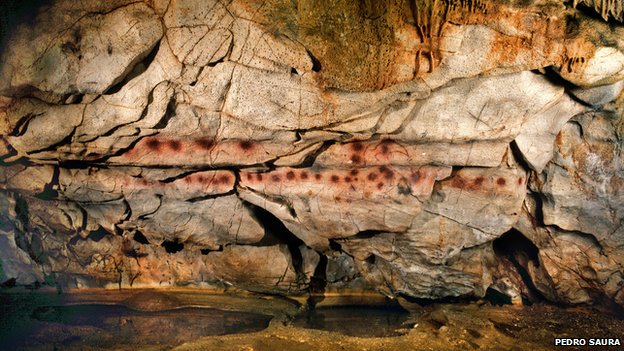
Science has published a report about new dates for paleolithic cave art in Spain. One of the oldest dates to emerge from dating the calcite deposits on the artwork is 40,800 years ago, on a red dot like the ones in the photo below.

Paleolithic cave art dot photo by Pedro Saura

To quote the abstract: “These minimum ages reveal either that cave art was a part of the cultural repertoire of the first anatomically modern humans in Europe or that perhaps Neandertals also engaged in painting caves.”

This last bit is particularly intriguing (and the web seems to agree with me; this story is everywhere today). One of the ways we define ourselves as human is the fact that we create symbolic art. Perhaps we aren’t the only species on this planet to have evolved the ability to use shape and color to capture the meaning we observe in the world around us.

More on the BBC, and read my review of Cave of Forgotten Dreams (Werner Herzog’s gorgeous 3D movie about Chauvet in France).