Category: Memoir

Of mammoths past and mammoths future

In the entrance hall of the Historical Museum of Hokkaido stand two enormous skeletons — a mammoth and a Naumann’s elephant, another type of woolly, Pleistocene proboscidean native to Japan. By the time I visited the museum at age three or four, I had seen living elephants at the Ueno Zoo in Tokyo and the Maruyama Zoo in Sapporo. The enormous curved tusks arched over my head, and I knew instantly that I was in the presence of something altogether different and wonderful.
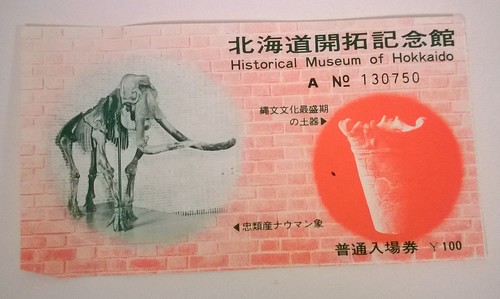
Historical Museum of Hokkaido ticket
An artifact: My mother saved the entrance ticket to the museum

We walked past cases of Jomon pottery and through the dark halls of ethnographic dioramas depicting Ainu lifeways. The museum opened just a few years earlier, in 1971, to commemorate the 100th anniversary of the Western-style colonization of Hokkaido by ethnic Japanese people following the Meiji Restoration. Hokkaido today is full of beautiful Victorian buildings that would be at home in any of the nicer neighborhoods of San Francisco, Chicago, or Seattle. As is typical the world over, the process of colonization did not go well for the aboriginal peoples. But I’ll save a discussion of the complexities of modern Japan as a multiethnic society for another day…

I got scared of the strange, dimly lit mannequins with their beards and furs, so my mother took me outside to walk around on the museum grounds, where we encountered a rock wall of hand stencils like the ones I’d see when I grew older, a motif that ties together Paleolithic cultures the world over.

Despite my fear, from that moment on, I became fascinated with humanity’s shared past. I needed to understand those other people who lived in a time when mammoths and aurochs roamed the open steppe. By the time I was 5 had learned that people who studied deep human history were called archaeologists, and the people who dug up mammoths were called paleontologists. As awed as I was by that mammoth, it was the people who intrigued me. Following the invariable fireman phase and a brief flirtation with wanting to be a ballerina (after seeing the Bolshoi Ballet perform Swan Lake), I knew I wanted to become an archaeologist.

When adults asked me, I would inform them of this fact, to which most would say, “So you want to dig up dinosaurs? That sounds like fun!”

“No,” I would reply, “That’s a paleontologist, like Louis Leakey in Africa. I want to become an archaeologist.”

By the mid-80’s, adults would then follow with “Oh, of course, like Indiana Jones!”

I’d sigh and say, “No, not like him. Indiana Jones is just a grave robber. I want to be like Heinrich Schliemann. He discovered Troy.”

Large proportions of my education having consisted of back issues of National Geographic and old sets of Encyclopædia Britannica, I was, in hindsight, rather insufferable.

There really are moments in the course of your life when it shifts to a new direction. In the years since, I’ve collected Jomon potsherds from carrot fields in Yokohama, participated in digs (the Tategahana Paleolithic site at Lake Nojiri and Tall al-`Umayri in Jordan), held Neanderthal tools in my hand, and pondered axial precession under Newgrange.

And yet, nothing will ever compare to my first sight of a mammoth skeleton that day back in Hokkaido. Some day, perhaps I’ll see one in the flesh…

That one time I swam to Myanmar (and back)

One day twenty years ago or so, somebody at my religiously affiliated high school thought it would be an excellent idea to send our choir to a school in the Mae La camp in Thailand to aid in the construction of a new building for Karen refugees, presumably as a demonstration of American largesse and Christian charity.

I could tell you about how I bathed in a river for a week, how I rode a genuine working elephant (not some tourist pachyderm), how two thirds of us got food poisoning, or how the concrete never properly set. I could tell you that we left having accomplished nothing more than two parallel ditches in a patch of red dirt that the local people had already cleared before we arrived.

I could wax political about the sheer, indecent waste of spending thousands of dollars each to send a bunch of American teenagers to do work that could have been done better, faster, and with positive economic impact for the local community. As a missionary kid myself, I could rail against the sheer arrogance and imperialism — that somehow these American children were making a difference or “helping” the local community.

I could remind everyone that the safe, secure, and “free” Yangon that Anthony Bourdain enjoys today is thanks to a successful military campaign to suppress all the ethnic minorities (such as the Karen) fighting in the countryside for self-determination.

But none of that is especially interesting, so I’ll tell you about the time I swam to Myanmar.

One afternoon after the church service, starring a special choir of children flown in all the way from America, we were walking along a riverbank back to the little village that surrounded the school. Our Karen guide — a fellow teenager from the school — pointed across the river and told us the other side was Burma. Unsupervised by adults and newly invigorated from having survived salmonella poisoning in the middle of the jungle, several American children thought it would be an excellent idea to swim the hundred meters or so across the Moei River, just so they could tell their friends and relatives back home that they had been to Burma.

“Just don’t go past the rocks on the shore — there could be mines,” the Karen girl said. Good to know.

Back home, I was the head lifeguard at our school. I didn’t need to be an adult to suggest that this was not, in fact, an excellent idea. Unswayed, several boys and girls waded into the river wearing their cargo shorts, T-shirts, and brand-new Tevas from REI.

I decided I could at least sit on a rock and make sure nobody died in the water.

Halfway across the river, the current caught one of the younger boys.

I called out, “Do you need some help?”

He nodded sheepishly as he drifted north toward the Salween River, thence south on to the Andaman Sea, the Bay of Bengal, and the Indian Ocean.

I took off my own Tevas (they were really big back in the 90’s) and I waded into the brown water. Once I was clear of the mud sucking at my feet, I dove forward and swam toward the floundering boy. I threw my arm over his shoulder and shoved my hip up under his, pulling him up and nearly out of the water — a move designed simultaneously to control and to calm. It’s also a move that puts the lifeguard mostly underwater.

“Just lean back and relax,” I said as I bobbed up and exhaled. A breath, one stroke, up again. “I’ve got you.”

Damned if I was going to play flag football or join junior varsity basketball, I had taken lifeguard certification twice for P.E. credit. This would be my first real-world rescue. But if I could subdue an ex-Marine Gulf War vet who outweighed me by a hundred pounds in our pool, I knew hauling a fifteen-year-old to safety in real life would be quite possible.

I looked up and realized we were closer to the far bank. I changed course and hauled him with my right arm as I scissor-kicked us the rest of the way to Burma. My feet touched round river stones and I pulled the boy upright.

“Let’s rest for a minute, and then I’ll haul you back. I think that’ll be easier.”

We sat there in Myanmar for about 10 minutes, tossing stones into the river.

Our return trip was uneventful. He floated on his back and I hauled him back to Thailand by his collar. (I suppose my story’s boring ending proves that it’s true. The most dramatic part of a good, made-up story isn’t in the middle.)

We never told the adults about all this — the choir director and the chaperones, the parents and teachers. We suspected nothing good would come of telling everyone else of this latest adventure.

On the desk in my office, among the trilobites and bifaces, sits an unprepossessing green stone — a souvenir hastily picked up from the banks of the Moei River, a memento of the day I swam to Myanmar and back.

Moei River on Wikipedia

A fairly well-populated section of the Moei River, nothing like the middle of the jungle where I swam across, hauling an embarrassed fifteen-year-old kid

The day I corrected Roger Ebert

The great movie critic Roger Ebert died today after a lengthy battle with cancer. It’s not often I’m personally touched by the passing of a “celebrity,” but Roger Ebert was first and foremost a writer, and someone into whose orbit I was inexorably but briefly pulled one day back in March 2006.

Roger Ebert

A young Roger Ebert in 1970

Seven years ago, Roger Ebert posted a review of V for Vendetta, observing:

Britain is ruled by a man named Sutler, who gives orders to his underlings from a wall-sized TV screen and seems the personification of Big Brother.

George Orwell’s Nineteen Eighty-Four is one of my favorite books, and the movie starring John Hurt is one of my favorite literary adaptations in cinema. So when I saw that John Hurt was playing Sutler, I thought Mr. Ebert had missed something. I hit the Send Feedback link and wrote a brief email:

Dear Roger,

Although you compared John Hurt’s character to Big Brother in your review of “V for Vendetta,” I’m a bit surprised that you didn’t note the irony inherent in the fact that Hurt played Winston Smith in “1984.” I think it was a brilliant piece of stunt casting.

Andrew Becraft
Seattle, WA

I never expected a reply. But a few minutes later, I got this amusing response from Roger Ebert himself:

Ohmigod. You;re right!

A few minutes later, he replied again:

I have now incorporated your insight into the review, for which I thank you.

I went back to the review, and Ebert had added:

And is: Sutler is played by John Hurt, who in fact played Winston Smith in “Nineteen Eighty-Four” (1984).

I wrote Roger back:

Excellent! We all have our little obsessions, and “1984” is one of mine.

All the best,

-Andrew

Again Roger replied:

I love the whole of Orwell — all his novels, and those four thick volumes gathering his miscellaneous writings.

Best,
RE

I was so tempted to continue talking movies and literature with the world-famous Roger Ebert in more and more of these brief exchanges, but I didn’t want to seem obsessive — even though I was giddily forwarding these little emails to all my friends and doing little dances at the office.

Exactly three months later, Roger underwent the first surgery that removed his ability to speak. The ultimate writer (the first film critic to win a Pulitzer Prize, back in 1975), he quickly turned to the web, embracing RogerEbert.com more than ever, along with the nascent social media boom. The written word became his voice, and his fan base grew and grew even as he mostly retired from public view.

I hear people today talking about how much he interacted with fans and engaged with them intellectually since his illness, but it’s obvious to me that Roger Ebert was doing exactly that long before Twitter or Facebook.

Roger Ebert loved what he did, and loved to share his passion with like-minded people — movie buffs, writers, and readers of great literature. For one afternoon seven years ago, I found myself sharing my love of George Orwell with the great and wonderful Roger Ebert.

The world of film will be a dimmer place without him.

My Fellow Americans [Part III]

Continued from Part I and Part II.

March 18, 2003

The candles wouldn’t stay lit. We walked around the police line and huddled on the north side of the Jackson Federal Building as we tried to light the tiny candles stuck inside plastic cups. Out front, banners flapped up into faces and it took two hands to hold our signs.

The daytime crowds had long since dispersed, and I counted twenty of us lining the curb, facing the street for the benefit of the occasional motorist driving through downtown at 9:00 o’clock on a Tuesday night.

At our backs, an equal number of Seattle police defended the empty building, lined against the glass windows in their finest riot gear. Feet shoulder-width apart, they carried plastic handcuffs looped on utility belts that sagged with pouches. Handguns in holsters, eyes forward behind plastic face shields, they carried rubber-bullet rifles with orange stocks across their chests, at the ready.

I was afraid of them. These were the men who had put down the anarchists in 1999, who had pushed, shoved, and dragged away those who’d marched down the wrong street earlier today.

We gave up on our candles and held onto our signs. Black marker streaking the paper in the rain, mine still read “Would Jesus bomb Iraq?”

Most drivers waved, honked, or flashed the peace sign, but one passenger in a red pickup leaned out of his window, pointed at my sign, and yelled, “Yeah he would, asshole!” before giving us the finger as his buddy hit the gas pedal and they screeched down Second Avenue.

The wind began to die. Cameramen and reporters stepped out of their vans to smoke. They set up lights and tripods for the 10 o’clock newscast, said some things we couldn’t hear from across the street, and then went back inside their vans. I have no idea what they said about us, standing there in the wind.

By 10:30, the only cars on the road were empty taxis. Cabbies began to slow as they passed us. As though a signal had gone out over the radio, they began to honk when they drove by. One driver lifted his hand through his window and raised his fingers in a V. Another pulled up alongside us at the curb, leaned over to roll down his window, and said, “For peace, yes? No war!” His teeth flashed in the dark under a black mustache.

“Yes, yes, peace,” I said. I wanted to say something in Arabic, to use the few words I’d learned over a summer digging up potsherds and goat bones in Jordan. But I couldn’t know where he was from.

“No war,” I said.

“Thank you very much!” he said and began to pull away.

A white and black motorcycle rolled down the hill from Marion, turned on its lights, and pulled over the taxi.

A second taxi drove past, honked, and a second motorcycle cop pulled him over.

Spotlights glared from the rear windows of the cabs. They let them both go, and the cops drove off into the dark.

Another taxi driver honked and waved. They were waiting for him, too. Again and again, red and white lights flashed off yellow paint.

The news crews remained hunkered in their white vans.