Category: Memoir

Finding a sense of place among the Becrafts of Sedro-Woolley, Washington

As a child of ex-pat parents who moved all over Japan before we moved “home” to the States when I was a teenager, there are few places on Earth I feel I’ve put down roots in the way those who were born and grew up in the same city, state, or even country feel they do. Oddly perhaps, this has given me the freedom to lay claim to whatever place I feel a deep connection to, from the darkened roads of Tillamook to Poets’ Corner in Westminster Abbey; from the inner chamber of Newgrange to the aircraft carrier USS Midway.

My feelings about family and cultural heritage are as convoluted as my sense of home. It might come as no surprise that my primary comfort food is cold soba noodles with fishy dipping sauce green with wasabi, but I also feel a warm glow of connectedness when I pick up a morsel of mesir wat with my shred of injera. After all, aren’t we all Ethiopian?

Nevertheless, I’ve felt an increasing compulsion to connect with my more recent family heritage over the last couple of years (resulting in exploration of my Loyalist Canadian lineage, for example). Living in Seattle today, I’m most interested in the stories of the first Becraft families who arrived here in the late 19th century.

Family photos show great-great-grandfather James Samuel Becraft with his logging crew in Skagit and Island Counties north of Seattle, but oral family history only seems to begin when James Samuel joined the Seventh-day Adventist church, and everything about the rest of his family and their ancestors remains a mystery.

James Becraft and McCoy Logging Crew

This next photo shows James S. Becraft with his father, James Thomas Becraft, about whom I knew very little until doing a bit of research.
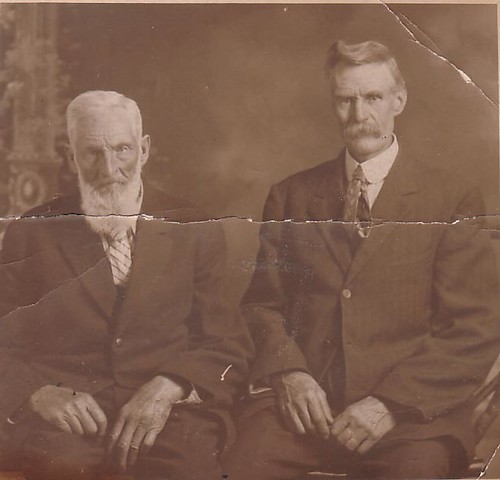
James Thomas and son James Samuel Becraft

As it turns out, James Thomas Becraft (born in 1827 in Booneville, Kentucky) traveled overland to Plumas County, California in 1853 with his wife Rebecca. He worked alternately as a gold miner and logger until 1873, when he became a farmer. Rebecca died in 1878, and by 1900, James T. had moved north to Oregon, then on to Sedro-Woolley, Washington by 1910 to live with his son Charles Edward, until James T. died the next year.

My wife and I visit friends in Sedro-Woolley fairly regularly, so I did a bit more research before a trip up there last week and confirmed that James T. Becraft was indeed buried in Sedro-Woolley. My friend Josh is a bit of a historian himself, so he and I drove to the Union Cemetery in Sedro-Woolley this past Saturday and scoured alternate rows for my relatives. There are seventeen Becrafts buried in Sedro-Woolley, and we had found nearly all of them — but not my direct ancestor James Thomas — when we called it a day and drove off.

As Josh sped up, I noticed what looked like a map on a sign by the side of the road, and I called “Wait!” He turned the car around and we began looking through the section of the cemetery we hadn’t noticed before, where Oddfellows were buried. Within a few minutes, we had found Great-Great-Great-Grandpa Becraft.

James Thomas Becraft gravestone

There’s a sense of place that emerges from the overwhelming cultural significance of the archaic structure one stands within — Newgrange or Westminster Abbey — and the sense of connectedness that place brings you as a member of the broader human species. But to stand before the grave of my forefather is another sense of place entirely and a very different kind of connectedness.

To the list of places where my roots spread beneath the ground, I now add Sedro-Woolley, one of my many homes.

Why I’m proud to be an American, and why that’s okay

I celebrated Canada Day earlier this week by embracing my Canadian heritage, but today is the 4th of July, Independence Day. Even though my family has a long history in America, I’ve struggled to feel a sense of belonging as an American all my life — something I’ve begun exploring in My Fellow Americans.

James Becraft and McCoy Logging Crew
My great-great-grandfather James Samuel Becraft with his logging crew in Skagit County, Washington in the 1880s or 1890s.

Too often, one person’s patriotism is simply militant nationalism experienced by another. What makes American patriotism such an important value, while Russian or Chinese nationalism remains something that so many Americans fear? Isn’t the latter simply patriotism — something so often touted as an inherent good? I would argue that patriotism and nationalism are two sides of the same coin, and both sentiments to be avoided if we don’t want to doom humanity to a future full of conflict. It’s hard for me to be proud of my country in relation to all others — especially in light of our nation’s darker moments.

Half-jokingly at first, I started a list earlier this week of “Things that make me proud to be an American,” beginning with corn dogs and baseball — both classic American inventions in that they (arguably) improve on the original ideas brought here by immigrants. As I added to the list, it became clear that there really are things that I’m proud of as an American. (I tweeted them all today, likely annoying a fair number of my few followers.)

The people of the United States have accomplished great things in our history, and we as a people can justly take pride in these achievements. People like Benjamin Franklin, Martin Luther King, Jr., Nikola Tesla, and Henry David Thoreau personify what it means to be American, and each has contributed enormously to the philosophy, science, and culture of our country. Each of these people has moved America forward.

Human beings are an inventive species. Throw enough of us on a continent and we’re sure to come up with some good ideas. The telephone and telegraph, combined with computers like ENIAC, programming languages like FORTRAN, and markup languages like GML, all set the stage for the Internet and the World Wide Web. Poets like Walt Whitman, Robert Lowell, and Galway Kinnell capture the American spirit like no others — from celebration to dissent. NASA and the US Space Program bring us closer to a life beyond this planet we were born on.

None of these accomplishments — whether scientific, artistic, technological, philosophical, or literary — diminishes what other nations have accomplished; all of them contribute not just to this nation’s future, but to the future of humanity itself.

Yes, I’m proud proud to be American, but I’m also proud to have been born in Japan, proud to be one quarter Canadian, proud of my Indian / First Nations heritage, and proud of my immigrant ancestors who arrived from England (1620 in Plymouth), France (1635 in Virginia), Holland (1652 in New Holland), Sweden (1654 in New Sweden), Ireland (1689 in Delaware), Germany (1741 in Philadelphia), and everywhere else.

This is the kind of pride in America that my foreign-born, cynical, liberal self can feel without guilt. Migration and innovation are inherent to the human experience, going all the way back to our first ancestors in Africa. Thus, my pride in American achievement and my own immigrant ancestry is simply pride in knowing that I’m both a result and an example of an innately human story.

Neolithic tools - 'Ain GhazalMost of all, I’m proud to be part of the human race — a species born in Africa, a people who invented language, music, art, agriculture, literature, and the science that will someday take us to the stars. For me, America is just one stop on the human road from Africa to the stars. I’m proud to have taken a few small steps with my fellow humans along that journey.

Celebrating 1/4 Canada Day

Today, one quarter of me celebrates Canada Day.

In 1783, the First American Civil War ended in the defeat of the Loyalist forces. Many chose to move north, uprooting their families long-established in New York, Pennsylvania, and New England. Among them were about one quarter of my ancestors — Jacob Segee (an officer in the Loyal American Regiment), Peter Snyder (born in Philadelphia to German immigrants), and many others.

My Loyalist ancestors founded Fredericton, New Brunswick. As with nearly everywhere on the continent, though, people had been living in that part of the world for decades, centuries, and millennia. French and Scottish fur trappers had also been settling there, marrying Algonquian-speaking First Nations women. One man named MacPherson married an Indian woman some time before the middle of the 19th Century, creating a Métis family. On the 1851 Census of Canada, Samuel Duncan MacPherson — my great-grandmother’s great-great-grandfather — and his family are listed as “Native” (even though his wife Eliza is actually a Segee descended from New Yorkers).

Fast forward to the early 20th Century, and my great grandparents William Clark and Velma MacPherson have arrived in Maine. I’m fortunate to have known six of my eight great-grandparents. I visited Great Grampy and Grammie at their home in Massachusetts in the 70’s, and several times after they’d continued their southward journey even farther, ultimately settling in Florida. According to the 1940 US Census, Grampy worked as a telegraph operator for a railroad company in Bangor, Maine. All I remember today is that Grampy liked Cadillacs and all-you-can-eat buffets and that Grammie carefully covered their living room furniture in plastic.

But today, I know so much more about these Canadian transplants and their families. I now know that I’m descended from both sides of the American Revolution, as well as both peoples who settled North America (the more recent within the last several hundred years, the other millennia earlier).

Knowing that, I can embrace my Canadian and First Nations heritage alongside the American heritage I’ll be celebrating in three days.

My Fellow Americans [Part II]

Continued from Part I.

1983

But then, my fellow Americans had dropped the bomb on Hiroshima. I sometimes forgot that, but then I’d remember the mannequins at the Peace Museum. By the time we were visiting Yokosuka on weekends, that mother and her son had been lurching toward me each night for years.

Just before we moved to Yokohama, my father’s parents visited us in Himeji. We climbed the Castle of the White Heron and ate handmade noodles at the counter of the noodle shop on the first floor of the building where my father had his church.

One trip I took alone with Grandpa Becraft. We were going to see pearl divers, robots that made cars for Toyota, and the Peace Museum in Hiroshima. I was seven, and he needed my Japanese skills to make sure he didn’t get lost. By age 10, I would be giving tours of Tokyo landmarks to visiting church dignitaries, for a small fee.

The oysters were gross, as were the black-and-white pictures of the ladies who used to dive for pearls without wearing any shirts. How long they could hold their breath did impress me. The robots were amazing, dipping and bobbing with shiny car parts clasped in their claws.

When we got to Hiroshima, we went to the Peace Park.

I gawked at the skeletal dome of the Industrial Promotion Hall. I wanted to become an archaeologist and I loved ruins. We listened to someone ring the bell. And then I noticed a two-story building across the plaza – the Hiroshima Peace Memorial Museum.

Hiroshima Peace Memorial Museum

I also loved museums. The first one I remember visiting was full of strange animals and scenes of Ainu men with beards and women with markings around their mouths that made them look like they had enormous blue grins. I wrapped my arms around my mother’s leg. She picked me up and carried me outside to look at a stone wall where someone had painted hundreds of handprints. But I wanted to go back inside with Father and look at those terrifying people behind the red ropes. I wanted to see the elephant with the brown hair again. I wanted to learn the names of each labeled artifact lying under glass and dim lights.

And so I pulled Grandpa past the Cenotaph and the thousand cranes, through school groups and old people following a lady with a yellow flag. Grandpa paid the admission fee and we entered. Immediately, I saw that this was like no other museum I’d been in. I took Grandpa’s hand as we stepped back forty years, to August 7, 1945.

The artifacts under the glass and dim lights in this museum were like nothing I’d ever seen before. Watches and clocks with their hands frozen at a quarter past eight. Melted bottles. Fused lumps of stone, metal, and glass. A hollow Buddha. A tricycle.

Pictures covered the walls. Grinning Americans stood under the nose of an airplane.

Enola Gay crew

A tall cloud climbed from the earth to the sky. Women bare-chested like the pearl divers, patterns from their cotton robes burned into their skin. Men with sores all over their bodies. Children my age balding in patches as their hair fell out.

There were diagrams with red and orange and yellow sections on a map. There were movies of houses blowing down in a great wind. There were drawings of a woman carrying a burned-black baby and a person with blue flames coming from their fingers.

We looked at the stone steps where a woman waiting for the bank to open had burned into thin air, leaving behind only her shadow.

Hiroshima bomb bank steps shadow

And then my grandfather and I were standing in front of those mannequins. Painted in the distance, a river I knew now was full of people whose thirst drove them down the banks to their death. Above the mother and her son, I knew clouds hung waiting to let fall black rain no better for drinking than the poisoned river. Their mouths hung open. Their hair stood up in bomb-blast afros. In my dreams, they would howl and moan. Skin dangled from their hands in strips.

I took Grandpa’s hand — a hand that learned to fire a rifle in 1944 as he trained in Hawaii for the invasion of mainland Japan, an invasion made unnecessary by the horror documented so meticulously all around us. Would he, and therefore I, be alive today if that bomb had never fallen?

Whether logic or rationalization, such thoughts did not enter my mind until many years later.

In that moment, aged 7, I’d never felt more ashamed to be an American.

1985

On the bridge of USS Midway, I thought of what this great machine was capable of, said “Thank you,” and climbed down from the captain’s chair.

March 2007

Nathan and I followed the man in the yellow CV-41 hat down the ladders and back into the glaring sun. We followed the exit signs, walked down the gangplank, and stepped onto the pier again.

Continued in Part III