I didn’t take naps. I don’t think I’d ever taken naps.
Father had church business with church elders next door, and he left me to play with the kindergarteners. At first, they stared at me, even though I wore the same clothes they all wore — blue shorts, white shirt, and round red hat.
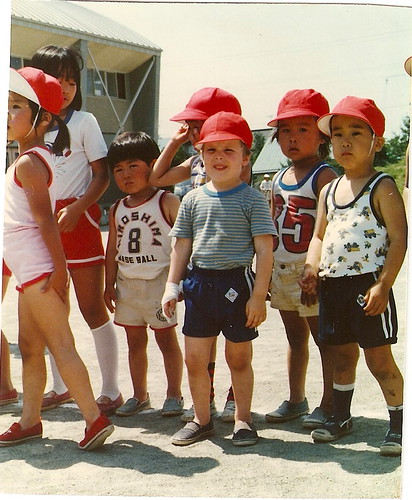
The oldest boy called me a gaijin and then laughed.
“I was born in Tokyo,” I corrected him, “I’m a Child of Edo, you Son of the Soil.” Some of the girls laughed.
I played on the swing. The toes of all the other children had scooped the dry sand from under the seats, leaving furrows beneath my feet. At the top of each arc, I could see our blue Subaru over the concrete wall, parked in the church driveway. I played hopscotch with the girls who were nice earlier. I let them win.
A bell rang and we all went inside to sing “Twinkle Twinkle Little Star.” When we sang “The Elephant Song,” I waved my arm from my face just like everyone else. The others were learning to count, but I already knew all ten of them so I was bored.
A lady in glasses and a green dress brought rice balls wrapped in seaweed and we each took one. I loved the saltiness of the black seaweed and the tang of the pickled plum in the center of the rice. The taste reminded me of staying over at Aunt Kiwako’s.
The teacher and the lady in green took mats from a closet and laid them on the floor. The others lay down quietly, some on their sides, some on their backs, some on their stomachs with an arm cradling their face. I told them I didn’t take naps but they didn’t care. They told me to lie down quietly and close my eyes.
I watched the red and green swirls behind my eyelids. I practiced counting to ten. I thought about the day before, when mother and I went to the park to meet father after work. I jumped over ditches and didn’t fall in. My favorite slide snaked down the hill, and I raced mother, me sliding in my corduroys, she running in her plaid skirt. I always won. Father came swinging his black briefcase.
When I woke up, we were on the highway home. I opened my eyes and pretended I hadn’t been sleeping. Some old ladies were planting shoots of rice in a field that we passed. They were probably singing.
Father said, “Did you sleep well? You must have had a lot of fun with all your new friends.”
“I wasn’t sleeping,” I said. “I don’t take naps. And they weren’t my friends.”
Rain began to streak the windows. Father flicked a knob and the windshield wipers started playing sumo. The one on the left always won. I turned to watch the power lines dip down, and then up, and then down again.


 Andrew-Becraft.com