Or, Information Architecture, Minimalist music, LEGO bricks, and a visit from the President of the People’s Republic of China
As I sat stuck on the bus yesterday for an hour and a half, crawling through traffic delayed and re-routed by an impending visit from President Xi Jinping of the People’s Republic of China, I listened for the first time to John Adams’ 1987 opera Nixon in China.
I grew up listening both to the masters of “traditional” classical music and to revolutionary 20th-century composers like Copeland and Stravinsky — the first CD I ever bought for myself, back in 1983 (the year CDs were released in Japan), was the Moscow Radio Symphony Orchestra’s recording of Stravinsky’s Rite of Spring. Later, I learned to love opera when I sang in the chorus for Carmen with the oldest active symphony west of the Mississippi (a fun fact about the Walla Walla Symphony). But despite passionate recommendations from Music Major friends in college, I’d never really dug particularly deeply into Philip Glass, Arvo Pärt, Terry Riley, or John Adams. Hearing The Chairman Dances on the radio over the weekend, I realized I’d been missing something.
Whether writing software documentation earlier in my career as a technical writer, specifications and user stories more recently as a product manager, or poetry and fiction whenever I can find the creative and emotional space to write it, music has always played a significant part in my writing process. From Bach and Beethoven to Johnny Cash and Sigur Rós, just about any music helps me focus and concentrate, while the right music can help me maintain the emotional state I want to explore when writing poetry in particular.
In 1983, my family moved from the medieval castle town of Himeji in western Japan to the outskirts of Yokohama. We had also lived in Yokohama for two years after I was born in Tokyo, and my minister father was being transferred back to work at his church’s headquarters in Asahi-ku. We lived in a mouldering compound of American ranch houses built for western missionaries. Constructed 40 years earlier in an era when American missionaries had Japanese maids, the houses even had a small apartment on the other side of the kitchen, behind the garage — a single tiny room with tatami mats and a bathroom with a deep Japanese furo that I sometimes preferred to the American bathtubs elsewhere in the house.
Through the power of satellite photography, I can see my old home, the easternmost house in the row of four toward the center of this screen capture (sent to me by a friend in 2011).
The first thing I learned in Yokohama was to drop my Kansai accent and start talking like the Kanto children around me.
One of the next things I was taught was that we lived atop a giant Jōmon midden. A midden is the kitchen scrap-heap of an archaeological site. Like the famous Tells of Middle Eastern archaeology, kitchen middens can grow to enormous proportions over the millennia as humans live near or on top of their growing garbage heap. Shell middens specifically include shellfish remains, but in Japan the term 貝塚 (kaizuka) is used as a general term for various types of archaeological middens, regardless of any evidence of actual shellfish processing at the site. Since the 1980s, archaeologists have clarified that our neighborhood sat on an upland terrace overlooking the Onda River valley — part of the larger Nagatsuta–Wakabadai Jōmon settlement complex, where overlapping habitation layers and midden deposits have surfaced for decades.
The Jōmon period (縄文時代) began about 16,000 years ago and lasted until the beginning of the Yayoi period (弥生時代) in about 300 BCE, with the introduction of rice-based agriculture. The Jōmon people made some of the earliest pottery in the world, but despite their sedentary lifestyle in villages and their intensive use of earthenware (土器), they were a predominantly pre-agricultural society of hunter-gatherers. Thus, the Jōmon period is considered transitional between the Paleolithic in Japan (旧石器時代) and the Iron Age Yayoi with their bronze bells, iron swords, and rice paddies.
Rather than a sudden leap from the Paleolithic to the Iron Age, the transition to the Yayoi period reflects a long process of interaction. Immigrant farming communities from the continent brought wet-rice agriculture and metal tools to regions already inhabited by Jōmon descendants, producing centuries of overlap and exchange.
Starting around 2,300 years ago, the Yayoi culture and the later Yamato culture steadily replaced the Jōmon culture. The Ainu people of Hokkaido preserve the highest proportion of Jōmon ancestry today, though genetic traces of these ancient islanders persist across all modern Japanese populations. With the colonization of Hokkaido following the Meiji Restoration in 1868, the invasion of the Yamato people across the islands of the Japanese archipelago was finally complete after more than two thousand years.
As I learned myself while attending Japanese elementary school in Yokohama, every Japanese child learns key archaeological details about the Jōmon period. Crafted without a wheel using coiled clay and fired in an open bonfire at fairly low temperatures, Jōmon potters often applied designs to their earthenware by pressing or rolling twine onto the wet clay. This is where the archaeological period gets its name: “Jōmon” means “rope-marked”.
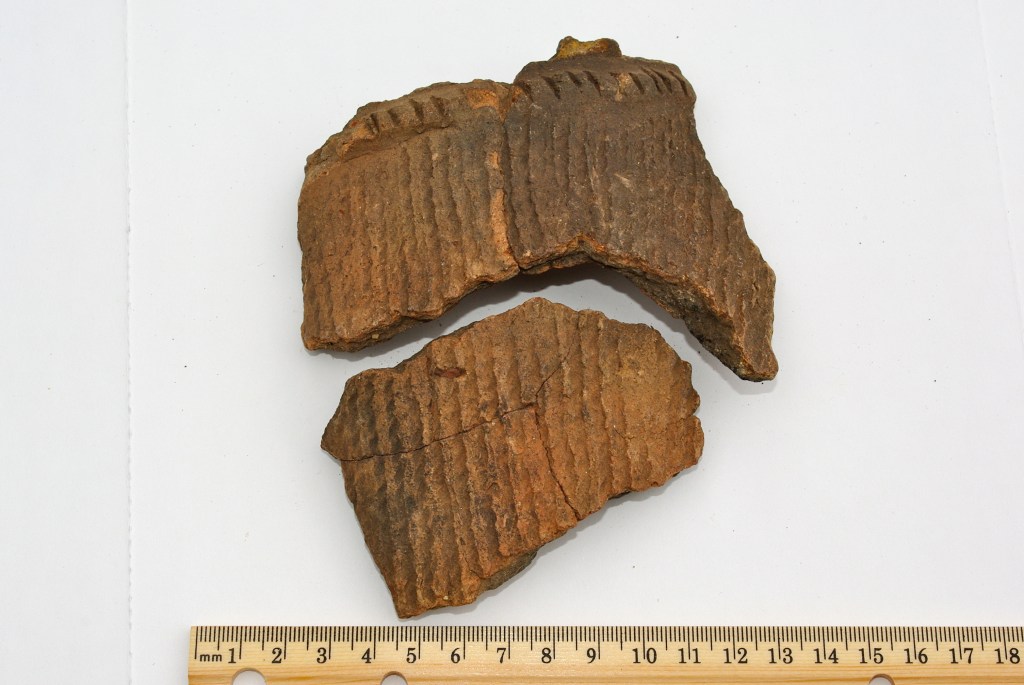
Archaeological sites are so common in the densely populated country that some go unexcavated. Near my home in Yokohama, modern machines with their ever-deeper plowing turned up more and more Jōmon potsherds in each furrow. Nearly every weekend for three years, I scoured the fields for these potsherds, hauling home plastic shopping bags full of broken pieces pressed with the classic, rope-marked pattern of pottery from the Early Jōmon phase (roughly 4,500–3,500 BCE).
A few years after we moved away from Yokohama, on a day when I must have felt particularly bored or lonely, I went through one of my boxes of sherds and managed to assemble a larger section from 6 different pieces. The hours I spent trying to fit potsherds together indicate just how seriously I took my future as an archaeologist.
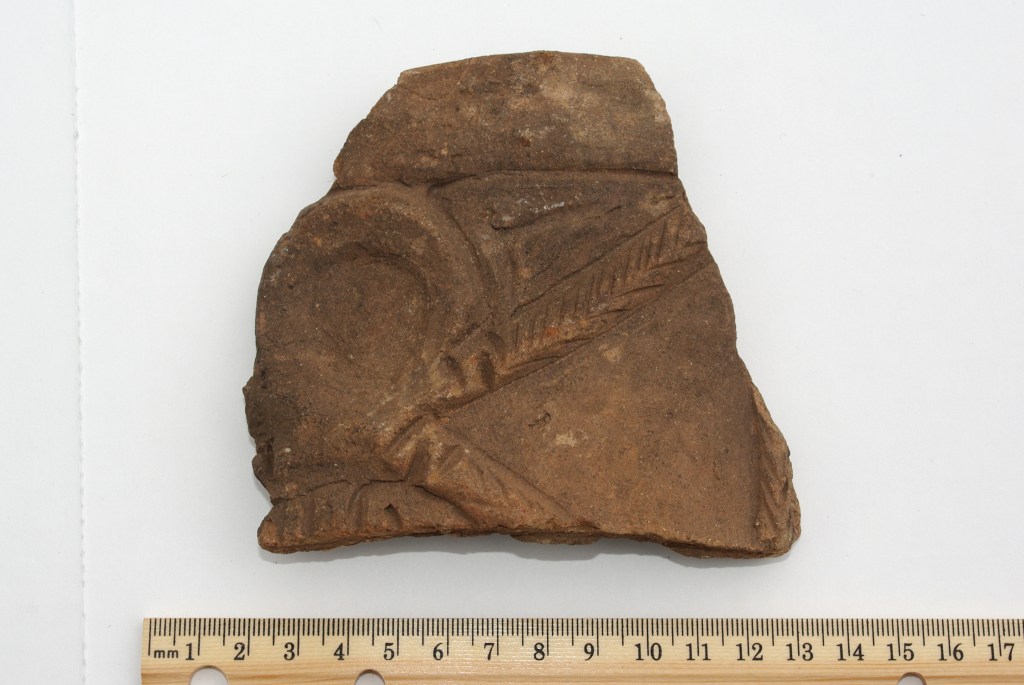
Every so often in Yokohama, I would find a more substantial potsherd, usually from a thicker vessel with the kinds of beautifully embossed patterns more typical of the Middle and Late Jōmon phases. Given their beauty, these were rare and exciting finds, even if the farmers didn’t seem to think so — they were usually tossed to the edge of the field like troublesome stones.
The vast carrot fields atop the hill to the north of our little American neighborhood yielded the most pottery — from small fragments to large sherds with ornate, swirling patterns.
In the years since a former neighbor emailed me a screenshot of our old houses on Google Maps, a new imaging pass has revealed that our four American-style oddities have been torn down, replaced by a modern neighborhood of over thirty proper Japanese houses. Similarly, the carrot fields to the north of the missionary compound have been replaced by the Wakabadai apartment complex — a convenient, one-hour train ride straight into downtown Tokyo.
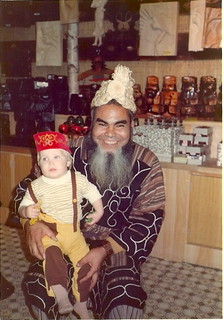
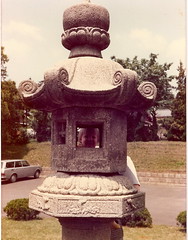
I can take a virtual walk along the Tomei Expressway to my old elementary school, and I can even see the shadow of the Japanese lantern where I had my picture taken when I was a baby. As I peruse photos taken from space of the Japanese streets I knew so well, while connected from my living room in Seattle to a global network of computers, it becomes clear how much has changed in just 30 years. Our satellites also look outward, finding unseen planets and revealing a universe of limitless wonder.
Yet, as I hold a 5,000-year-old Jōmon potsherd in my hand, I wonder what we’ve lost beneath all those apartment buildings, the bank, the ramen shop, and the train station with its express service to Shinjuku. What do we destroy when we pave over ten thousand years of history for another hamburger joint? But even as urban growth erased the visible traces, rescue archaeologists were racing ahead of the bulldozers, documenting sites just like ours — a reminder that every lost field may still whisper its story through the fragments we kept.
How will future archaeologists assess these first layers as they scrape away our present and reveal the past we share with them?
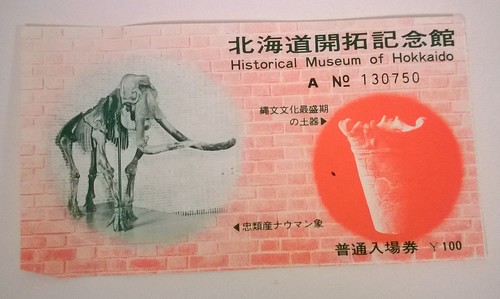
In the entrance hall of the Historical Museum of Hokkaido stand two enormous skeletons — a mammoth and a Naumann’s elephant, another type of woolly, Pleistocene proboscidean native to Japan. By the time I visited the museum at age three or four, I had seen living elephants at the Ueno Zoo in Tokyo and the Maruyama Zoo in Sapporo. The enormous curved tusks arched over my head, and I knew instantly that I was in the presence of something altogether different and wonderful.
An artifact: My mother saved the entrance ticket to the museum
We walked past cases of Jomon pottery and through the dark halls of ethnographic dioramas depicting Ainu lifeways. The museum opened just a few years earlier, in 1971, to commemorate the 100th anniversary of the Western-style colonization of Hokkaido by ethnic Japanese people following the Meiji Restoration. Hokkaido today is full of beautiful Victorian buildings that would be at home in any of the nicer neighborhoods of San Francisco, Chicago, or Seattle. As is typical the world over, the process of colonization did not go well for the aboriginal peoples. But I’ll save a discussion of the complexities of modern Japan as a multiethnic society for another day…
I got scared of the strange, dimly lit mannequins with their beards and furs, so my mother took me outside to walk around on the museum grounds, where we encountered a rock wall of hand stencils like the ones I’d see when I grew older, a motif that ties together Paleolithic cultures the world over.
Despite my fear, from that moment on, I became fascinated with humanity’s shared past. I needed to understand those other people who lived in a time when mammoths and aurochs roamed the open steppe. By the time I was 5 had learned that people who studied deep human history were called archaeologists, and the people who dug up mammoths were called paleontologists. As awed as I was by that mammoth, it was the people who intrigued me. Following the invariable fireman phase and a brief flirtation with wanting to be a ballerina (after seeing the Bolshoi Ballet perform Swan Lake), I knew I wanted to become an archaeologist.
When adults asked me, I would inform them of this fact, to which most would say, “So you want to dig up dinosaurs? That sounds like fun!”
“No,” I would reply, “That’s a paleontologist, like Louis Leakey in Africa. I want to become an archaeologist.”
By the mid-80’s, adults would then follow with “Oh, of course, like Indiana Jones!”
I’d sigh and say, “No, not like him. Indiana Jones is just a grave robber. I want to be like Heinrich Schliemann. He discovered Troy.”
Large proportions of my education having consisted of back issues of National Geographic and old sets of Encyclopædia Britannica, I was, in hindsight, rather insufferable.
There really are moments in the course of your life when it shifts to a new direction. In the years since, I’ve collected Jomon potsherds from carrot fields in Yokohama, participated in digs (the Tategahana Paleolithic site at Lake Nojiri and Tall al-`Umayri in Jordan), held Neanderthal tools in my hand, and pondered axial precession under Newgrange.
And yet, nothing will ever compare to my first sight of a mammoth skeleton that day back in Hokkaido. Some day, perhaps I’ll see one in the flesh…
Closing out my conference junket for 2014, I’m at Information Development World in sunny San Jose, California. Content reuse is not the only tactic you can apply as part of your content strategy to reduce cost and improve discoverability.
How often have you proudly described the great big manual or Help system you just finished writing to your fellow tech writers, your manager, or even potential employers? But how much of that bulk was really necessary? How do you decide when you have too much content? How do you decide which content stays and which lands in the archive? Applying metrics-driven lean content principles & practices as part of your content strategy can not only save you money on maintenance and localization, but more importantly it can make your content more discoverable and usable.
In this session, I’ll provide both strategic advice on how to decide whether you need to streamline your content, as well as practical suggestions about the tools and techniques you can use to make the streamlining process successful.
EDIT: You can now see my full presentation on SlideShare.



 Andrew-Becraft.com