Tag: Archaeology

Dots in the dark

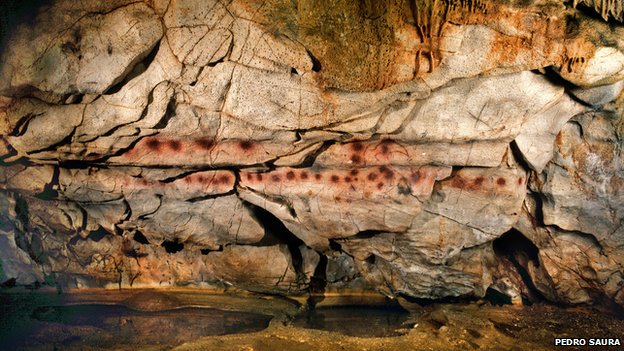
Science has published a report about new dates for paleolithic cave art in Spain. One of the oldest dates to emerge from dating the calcite deposits on the artwork is 40,800 years ago, on a red dot like the ones in the photo below.

Paleolithic cave art dot photo by Pedro Saura

To quote the abstract: “These minimum ages reveal either that cave art was a part of the cultural repertoire of the first anatomically modern humans in Europe or that perhaps Neandertals also engaged in painting caves.”

This last bit is particularly intriguing (and the web seems to agree with me; this story is everywhere today). One of the ways we define ourselves as human is the fact that we create symbolic art. Perhaps we aren’t the only species on this planet to have evolved the ability to use shape and color to capture the meaning we observe in the world around us.

More on the BBC, and read my review of Cave of Forgotten Dreams (Werner Herzog’s gorgeous 3D movie about Chauvet in France).

Hatshepsut’s temple at Deir el-Bahari in LEGO

Cross-posted from The Brothers Brick.

When I visited Deir el-Bahari back in 1994, our Egyptian guide told us an easy way to remember the name of the pharaoh who had the colonnaded temple built for herself near the Valley of the Kings and Luxor. “Hot sheep suit,” he said. “You know, hot, like the sun, with a suit made from sheep.” The weather forecast placard in the hotel lobby had informed us it was going to be 45° C (113° F) that day. Standing there in the blazing desert sun, it was hard to imagine wearing a wool suit. And today, it’s hard to forget how to pronounce Queen Hatshepsut’s name.

Similarly unforgettable was her mortuary temple, here recreated wonderfully in LEGO by Harald P. (HP Mohnroth).

lego_architecture_deir el bahari

See many other wonderful LEGO models of historical structures in Harald’s LEGO Architecture set on Flickr.

The alien past

There are shared themes between the science fiction and archaeology books I’ve been reading lately. There’s a sense of otherness, of alien intelligences glimpsed across a void.

Göbekli Tepe

Photo by Vince Musi from National Geographic

As little as we know about the builders of Newgrange in Ireland, we know even less about the builders of Göbekli Tepe in Turkey. What we do know about these monuments is that the first were built about 11,000 years ago, during the earliest years of the Eurasian Neolithic. In other words, Göbekli Tepe predates our current understanding of when agriculture began. (And yes, it also predates Stonehenge — by six or seven thousand years.) It’s hard to imagine what motivated tribes of hunter-gatherers to create such monumental architecture, full of animal sculptures and mysterious standing stones. It’s also hard to conceive of why each succeeding structure grew smaller and less sophisticated over time.

So this is where archaeology, science fiction, and poetry all converge. As a poet, archaeology enables me to explore that alien otherness while remaining grounded in the scientific reality of human experience.

More about Göbekli Tepe: