Tag: Japan

Of mammoths past and mammoths future

In the entrance hall of the Historical Museum of Hokkaido stand two enormous skeletons — a mammoth and a Naumann’s elephant, another type of woolly, Pleistocene proboscidean native to Japan. By the time I visited the museum at age three or four, I had seen living elephants at the Ueno Zoo in Tokyo and the Maruyama Zoo in Sapporo. The enormous curved tusks arched over my head, and I knew instantly that I was in the presence of something altogether different and wonderful.
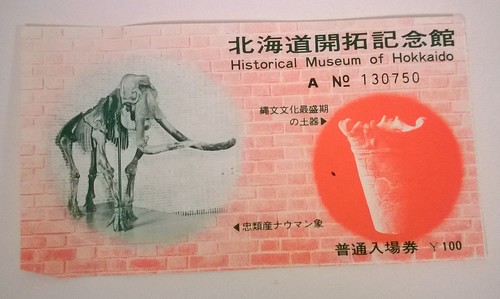
Historical Museum of Hokkaido ticket
An artifact: My mother saved the entrance ticket to the museum

We walked past cases of Jomon pottery and through the dark halls of ethnographic dioramas depicting Ainu lifeways. The museum opened just a few years earlier, in 1971, to commemorate the 100th anniversary of the Western-style colonization of Hokkaido by ethnic Japanese people following the Meiji Restoration. Hokkaido today is full of beautiful Victorian buildings that would be at home in any of the nicer neighborhoods of San Francisco, Chicago, or Seattle. As is typical the world over, the process of colonization did not go well for the aboriginal peoples. But I’ll save a discussion of the complexities of modern Japan as a multiethnic society for another day…

I got scared of the strange, dimly lit mannequins with their beards and furs, so my mother took me outside to walk around on the museum grounds, where we encountered a rock wall of hand stencils like the ones I’d see when I grew older, a motif that ties together Paleolithic cultures the world over.

Despite my fear, from that moment on, I became fascinated with humanity’s shared past. I needed to understand those other people who lived in a time when mammoths and aurochs roamed the open steppe. By the time I was 5 had learned that people who studied deep human history were called archaeologists, and the people who dug up mammoths were called paleontologists. As awed as I was by that mammoth, it was the people who intrigued me. Following the invariable fireman phase and a brief flirtation with wanting to be a ballerina (after seeing the Bolshoi Ballet perform Swan Lake), I knew I wanted to become an archaeologist.

When adults asked me, I would inform them of this fact, to which most would say, “So you want to dig up dinosaurs? That sounds like fun!”

“No,” I would reply, “That’s a paleontologist, like Louis Leakey in Africa. I want to become an archaeologist.”

By the mid-80’s, adults would then follow with “Oh, of course, like Indiana Jones!”

I’d sigh and say, “No, not like him. Indiana Jones is just a grave robber. I want to be like Heinrich Schliemann. He discovered Troy.”

Large proportions of my education having consisted of back issues of National Geographic and old sets of Encyclopædia Britannica, I was, in hindsight, rather insufferable.

There really are moments in the course of your life when it shifts to a new direction. In the years since, I’ve collected Jomon potsherds from carrot fields in Yokohama, participated in digs (the Tategahana Paleolithic site at Lake Nojiri and Tall al-`Umayri in Jordan), held Neanderthal tools in my hand, and pondered axial precession under Newgrange.

And yet, nothing will ever compare to my first sight of a mammoth skeleton that day back in Hokkaido. Some day, perhaps I’ll see one in the flesh…

The poetry of Thien Pham’s Sumo [Review]

As I wrote when reviewing Alan Moore and Dave Gibbons’ Watchmen, the graphic novel form enables the writer and artist to explore structure in ways that are more overt than the purely written word. In fact, I would argue that the techniques I’ve observed in great graphic novels — the way sections echo each other, how the artist alludes to things beyond the immediate page, and even the layout of the panels — shift graphic novels along the spectrum of literary genres away from “regular” novels and more toward poetry.

The structural similarity between graphic novels and poetry is, for me, most evident in Sumo, the first solo work by Thien Pham, published last year by First Second.

Sumo tells the story of Scott, an American who moves to Japan to pursue a career as a professional sumo wrestler after his girlfriend dumps him and his NFL dreams have been dashed.

But first, a few words about the greatest sport on earth.

I grew up following sumo in the era of Chiyonofuji and Konishiki. Back in Japan in the 70’s and 80’s, my classmates and I marked off a ring in the dirt of the schoolyard, stamped our feet, slapped our hands, and then slammed into each other until one of us fell over or stepped out of the ring. My hero was not, as you might expect, the American-born Konishiki, but Chiyonofuji — smart, and light on his feet. A chorus of 「ずるい!」 (“Not fair!”) would erupt when I’d side-step a much-larger boy and propel him stumbling from the ring with a shove between his shoulder blades. In my defense, I’d just mention Chiyonofuji’s most recent win against the likes of the monumental Konishiki and they would fall into grumbling acceptance.

I love sumo, from its ancient Shinto traditions to the way the modern sport has begun to open its doors to American, Russian, Bulgarian, and — most successfully of late — Mongolian wrestlers. It’s beautiful in ways that I can’t explain to someone who didn’t grow up watching it on NHK and mimicking the previous night’s bouts with your friends in a dirt ring you marked off yourself.

I don’t know anything about Sumo author Thien Pham beyond what appears on the book jacket — “Thien Pham is a comic book and visual artist based in the Bay Area. He is also a high school teacher.” Somehow, Pham manages in this small graphic novel — barely breaking a hundred pages — to encapsulate all that is wonderful about sumo.

Like the sport itself, Sumo is a minimalist work of art — as sumo is to ballet, Sumo is to poetry. Pham eschews both sound effects and thought bubbles. Everything you learn about Scott and his journey happens through action and dialogue. The beauty of some of that action lies in stillness and simplicity, with long sequences in Sumo showing nothing on the page but single-color illustrations.

Sumo is a story whose power lies in the convergence of three story threads — Scott as he prepares to leave for Japan; his early days there and friendship with the sumo stable master’s daughter; and his life as a wrestler rising through the ranks of professional sumo. Pham uses three separate colors to highlight each story, and intertwines them throughout the novel.

When Pham ties all three threads together at the end, the real emotional impact of Scott’s story becomes apparent. I won’t spoil it for the reader, but the hair stood up on my arms and the back of my neck.

Such a deep effect is something I encounter rarely, even in the best poetry. I heartily recommend Thien Pham’s Sumo and eagerly anticipate his next work.

Hashima / Gunkanjima – a perfect lair for a Bond villain

The latest James Bond film, Skyfall, features Javier Bardem as a classic Bond villain with an equally classic lair on an abandoned island. As I learned watching a recent episode of Top Gear about Bond cars, the crew prefers reality to effects whenever possible, so I shouldn’t have been surprised to learn that Silva’s lair is a real place — Hashima (also known as Gunkanjima), off the coast of Nagasaki in Japan.

Hashima or Gunkanjima ruins

Photo by Jordy Theiller

The island was a company town operated to mine coal starting in 1887, but abandoned in 1974. Reminiscent of Pripyat near Chernobyl, check out lots more photos on Haikyo.org and Gakuranman.

Via Boing Boing.

Sengoku Avengers

Growing up in Japan, I didn’t have too many opportunities to read American comic books. But between the superhero movies of this past decade; a crash course in Moore, Miller, and Gaiman (more on that in a separate post); and a weekend at Emerald City Comic-Con, I’ve realized that I’m much more a Marvel fan than a DC Comics fan.

Artist Alex Mitchell combines two of my favorite things to put a distinctly Japanese twist on the Avengers.

Sengoku Avengers

Via Neatorama.