It’s April 30, 2019 in Tokyo as I write this, and just a few hours from now, Emperor Akihito at age 85 will abdicate and bring to an end the … Continue reading Forever a Princess: For me, the Japanese Imperial Family will remain Empress Michiko
Category: Writing
My first book is on store shelves now: And it’s a Star Wars book!
I tend to keep my LEGO hobby fairly compartmentalized — with a handful of exceptions, I don’t write much about little plastic bricks here on Andrew-Becraft.com. Topics here on my personal/professional website tend more toward science (archaeology in particular), poetry, software design methodology, and occasionally the convergence of multiple interests after I have some kind of late-night epiphany.
But writing and LEGO have converged today with the release of my first book, Ultimate LEGO Star Wars. Written together with Chris Malloy, one of my team members from The Brothers Brick, Ultimate LEGO Star Wars is a coffee table reference book from British publisher Dorling Kindersley (DK). You can read more about the book itself and our experience writing it in an interview over on The Brothers Brick, but I thought I’d reflect here on my personal experience today as the book begins hitting store shelves.

Remembering Chiyonofuji, my childhood hero (1955-2016)
Contrary to the perception of many westerners, sumo is a game of speed and strategy, in which wrestlers assess their opponent’s weaknesses — psychological as much as physical — and attempt to outmaneuver quickly in order to get the upper hand. All sumo wrestlers are incredibly strong, but many also bulk up in order to give themselves an advantage in the ring. Not so with Chiyonofuji (千代の富士), who began his career in the early 1970s and retired in 1991 — spanning all the years I spent in Japan as a child. Some of the first foreign wrestlers came to prominence during that same time, Takamiyama (from Hawaii) and Konishiki (a Hawaiian born Samoan), but I always identified more with the little guy in the black mawashi.
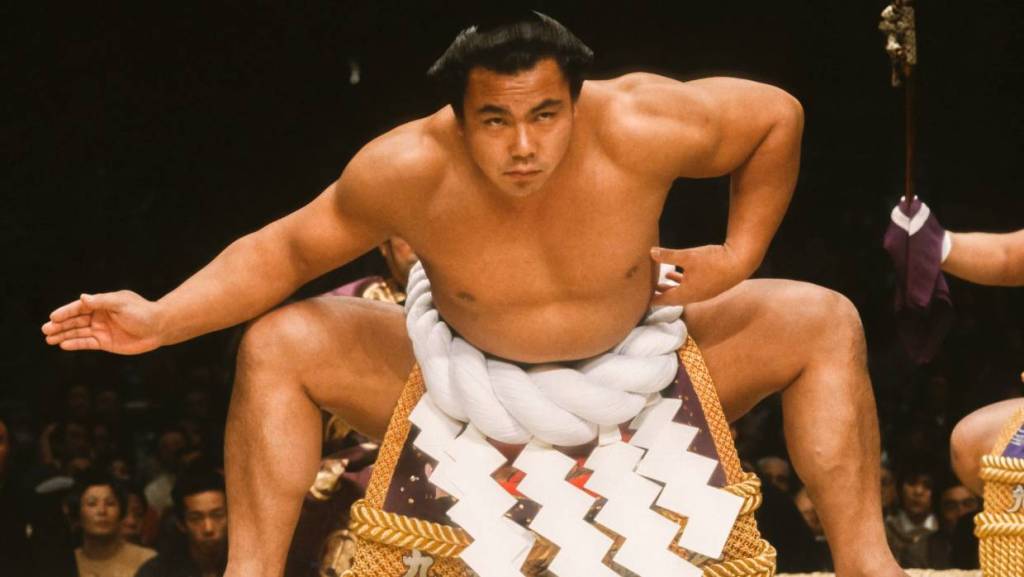
The month before my family left for the States, I watched my last sumo tournament in Japan, during which Konishiki handily defeated Chiyonofuji by shoving him out of the ring with an “oshidashi.”
And it was hard not to root for the American-born Konishiki when he beat the already legendary Yokozuna during their first match in 1984.
But it was all the smart moves he had made during the previous 15 years that left such an impression on me, often employing his much-feared “uwatenage” (literally “upper hand throw”).
As an American kid attending a local Japanese school, I was different from my Japanese classmates in both obvious and less-obvious ways. Children all over the world can be incredibly cruel to anybody who’s different, and I was the frequent victim of schoolyard bullies. Chiyonofuji proved that being bigger and stronger did not always result in victory — outthinking your adversary is far more important.
Paleolithic archaeology, software design, and the social brain
Over the past 18 months, I’ve immersed myself deeper and deeper in the Paleolithic, reading scores of books and journal articles. Why?

Ever since my first visit at about age four to the Historical Museum of Hokkaido, with its mammoth skeletons and Paleolithic dioramas, I’ve been fascinating by the archaeology of deep human history (as Clive Gamble puts it in the subtitle of his exceptional book Settling the Earth). I wandered by chance onto the Tategahana Paleolithic Site at Lake Nojiri in Nagano during an excavation, walked carrot fields in Yokohama looking for Jomon potsherds, and when I traveled to Jordan during college for an Iron Age dig, I spent my evenings surface-collecting Middle Paleolithic tools from a nearby barley field. The vast, mostly unknown and seemingly unrelatable world of the Stone Age seems so much more interesting than the thoroughly modern world of Archimedes, Hadrian, and Augustine of Hippo.
(more…) Andrew-Becraft.com