-
Gaiman, Miller & Moore – a literary education in American comic books
First, I must acknowledge the irony of this post title: I’m well aware that two of the “American” comic book writers whose work I’ll write about here aren’t American at all — Neil Gaiman and Alan Moore are English. Second, I also know that the works themselves are better categorized as graphic novels. Read on…
Friends and visitors to this blog will likely already know that I was born and raised in Japan. I grew up whiling away summer afternoons to the music of warblers and cicadas, reading Akira Toriyama, Machiko Hasegawa, Fujiko Fujio, and of course Hayao Miyazaki. Although I haven’t revisited my childhood reading of Toriyama’s Dr. Slump or Fujiko Fujio’s Doraemon, a complete seven-volume set of Miyazaki’s epic manga version of Nausicaä of the Valley of the Wind
During an island getaway this summer (the air filled with the music of frogs and goldfinches), I reread Nausicaä in Japanese, and in so doing realized how little I actually know about comics in my other mother tongue. My only exposure to American comic books was through cousins I visited in America every few years. Reading G.I. Joe, Archie, and X-Men in the mid-80’s, I was more entertained by the silly (now classically nostalgic) ads for Sea Monkeys. Even as a pre-teen, the newsprint felt cheap, the artwork struck me as jarring, and the plot lines couldn’t compare to the domestic satire of Sazae-san or the wonderfully wacky adventures of Doraemon and his hapless pal Nobita.
(In contrast, I’ve admired and deeply enjoyed the new breed of movies in the last ten years based on superheroes, from the Sam Raimi Spider-Man trilogy and various Marvel Universe films leading up to The Avengers to the heartbreakingly spectacular first two movies in Christopher Nolan’s Batman trilogy — heartbreaking for both the loss of Heath Ledger and for the underwhelming conclusion to the trilogy. Without the baggage of a childhood full of American comic books, I’m able to watch these movies with no expectations about origin myths, anticipated romance, or primary nemeses.)
Compounded by the intense sense of cultural dislocation I felt during Emerald City Comicon earlier in the year, I determined to correct at least some of my comic book illiteracy by tackling four of the most iconic works in the genre — Watchmen
and V for Vendetta
by Alan Moore, The Sandman Vol. 1: Preludes & Nocturnes
by Neil Gaiman, and Batman: The Dark Knight Returns
by Frank Miller.
These four graphic novels have served as the best introduction to American comic books an uninitiated adult reader like me could hope for. In the posts that follow over the coming days and weeks, I won’t debate the place each of these books holds within the literary canon, so strict formalists should gird themselves for a bit of reader-response criticism with a bit of the historical-critical method thrown in.
Stay tuned…
-
Sengoku Avengers
Growing up in Japan, I didn’t have too many opportunities to read American comic books. But between the superhero movies of this past decade; a crash course in Moore, Miller, and Gaiman (more on that in a separate post); and a weekend at Emerald City Comic-Con, I’ve realized that I’m much more a Marvel fan than a DC Comics fan.
Artist Alex Mitchell combines two of my favorite things to put a distinctly Japanese twist on the Avengers.

Via Neatorama.
-
Yeats at 4th & Madison
Girls in small glasses and men in long coats
wait for their buses. Beyond the bank,
behind the courthouse, the highway and hotels,
there are places you and I cannot see.Stairs lead halfway up a hill. Climb them.
A hedge has no gate. Walk through it.
Leaves spin in the road. Step into the wind.
Piled stones shift in the grass. Stand atop them.Above the highest step, through the hedge,
carried on the air with the whirling leaves,
balanced on rocks tumbling from beneath your feet,
you’ll find the world that shimmers and glows.In the space between those buildings and buses,
take my hand and close your eyes. Go there with me now. -
Endless forms most beautiful and most wonderful
And now, for no particular reason other than that they are wonderful, a list of my favorite animals.
The woolly rhinoceros (Coelodonta antiquitatis)

The domestic Dog (Canis lupus familiaris)

The orangutan (Pongo pygmaeus & P. abelii)

Cephalopods (class Cephalopoda)

The tiger (Panthera tigris)

The Japanese rhinoceros beetle (Allomyrina dichotoma)

The orca (Orcinus orca)

The trilobite (class Trilobita)

-
7 minutes of terror behind us, years of joyful exploration ahead
24 hours ago, I held my breath with the team at NASA’s Jet Propulsion Laboratory as they waited for the Mars Curiosity Rover to roar through the Martian atmosphere, deploy its supersonic parachute, fire its rockets, and get lowered to the surface of the Red Planet via “sky crane.”
Afterward, I stayed up to watch the press conference. In his comments, Adam Steltzner, lead engineer for EDL (entry, descent, and landing) said, “We humans are toolmakers, explorers, agriculturalists, pioneers.”
Of all the comments made by NASA/JPL team members last night, this brief comment really struck home. Steltzner weaves the story of this landing of one robotic rover into the fabric of our greater human story — from paleolithic toolmaking, neolithic agriculture, and the spread of Homo sapiens across the globe through our next steps to our sister planets and beyond.
NASA Administrator Charles Bolden‘s introduction made me proud to be American, but Adam Steltzner made me proud to be a human being.
Here’s one of the first, low-resolution pictures Curiosity took through a dust cover on a “Haz Cam”:

And here’s a spectacular photo of Curiosity parachuting down to Mars, taken by the Mars Reconnaissance Orbiter:
![Curiosity Parachute Landing Spotted by NASA Orbiter [detail]](https://i0.wp.com/farm8.staticflickr.com/7129/7727084702_994e140f7d.jpg)
We can expect high-resolution color photos later this week.
-
One small step
NASA and space exploration have always been one of the things that makes me proud to be an American. Today in 1969, humans stepped foot on another celestial body for the first time.

Neil Armstrong and Buzz Aldrin’s moon landing remains one of the singular achievements of the human race. My hope remains that I will live to see our species send representatives to the Moon again, and then on to Mars.
-
Literary decay
There’s something lovely about abandoned books. They’re somehow beautifully tragic in their dusty, moldy state, and yet still full of potential — whether it’s to be rescued, taken to a new home (as I’ve done with several books I’ve found in abandoned houses and barns) and perhaps read once more, or turned into something new. James Charlick found this abandoned library in a manor house while doing a bit of urban exploration.

Via Boing Boing.
-
Guy Laramee’s literary landscapes
Artist Guy Laramee sculpts complex miniature landscapes from books. His latest series was inspired by the tsunami in Japan last year, followed two days later by the death of his mother.
Laramee has turned this Japanese dictionary into a piece titled “In Advance of a Broken Land”.

-
打ち寄せる古里の波
You can also read the earlier English version of this poem.
その瞬間、砂に立ちながら気付いたのは
足下のがらくたが何であること
流木にもつれ合っている
羽毛でまだらの
昆布にまつわりつかれた物蕎麦屋の壁、酒屋の屋根
数え切れない住宅から
黄色い絶縁体の塊台所と居間から
浴室と寝室から
醤油がまだ中に流れる瓶
紅茶と麦茶と歯ブラシ
テレビ高潮がうちよせた曲線を歩む我
割れたサンダルをまたぎ
長靴の靴底を渡るこの物一つ一つは意味があると解った
ただのゴミではない
だれかが捨てた物でもない
あの晴れた金曜日の午後
緊急警報が放送された一瞬
おじいちゃんは
テレビで何を見ていたのか床が震え、
戸棚から料理の材料が
霰のように降り
近所の人々が外で叫び出したとたん
おばあちゃんは
どのような食事を準備していたのだろう前は避難勧告が鳴り響き
後は海のとどろき
走れるところも無く
おばあちゃんは階段で靴を無くしたのだろう一万キロ離れた我はその夜
母国が流されるのを観た
故郷の土で黒く染められた波
木製の風浪古里へ戻ることは出来ない
この砂浜でそれは分かった
しかしながら、
黒く染められた波に乗り
木製の風浪に運ばれ
古里は我の足下に流されていた。 -
Visiting the Space Shuttle FFT & touring a B-17 at the Museum of Flight
A couple weeks ago, I watched NASA’s Super Guppy flying in the crew compartment section of the Space Shuttle Full Fuselage Trainer (FFT). Today, I checked it out while it was being reassembled at the Museum of Flight here in Seattle.

Yes, it’s made of wood, but every shuttle astronaut was trained in the FFT, and the last crew even signed their names under the nose — it’s an important part of NASA history. One of the wonderful things about Seattle getting the FFT rather than one of the actual shuttles is that visitors to the museum will be able to go through it, as we can do today aboard the first jet-powered Air Force One, a Concorde, and one of the last B-17 bombers still in flying condition.
As much as I’m anticipating a tour of the FFT, I was most inspired today by a walk-through — more of a crawl-through, really — of that Boeing B-17 Flying Fortress. The “Boeing Bee” is one of only a handful of B-17’s still capable of taking to the skies. The bomber was manufactured just up the road from the Museum of Flight, and our docent was a retired Boeing engineer, able to rattle off both technical details and war stories with equal panache.
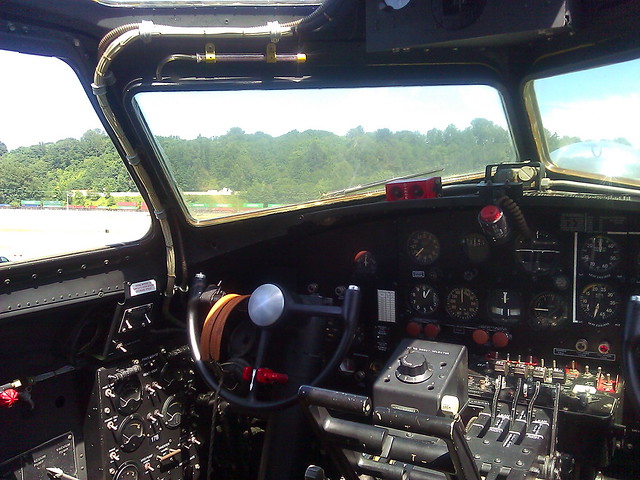
After squeezing around the ball turret, through the radio room, across the bomb bay, and into the cockpit, it wasn’t difficult to imagine how hellish it must have been for the ten-man crew, flying into German flak and fighters. But with thousands of pounds of bombs and eleven .50-caliber machine guns sprouting from just about every surface, the B-17 dealt death to the world below in equal measure.
Standing there in the July sun outside the Museum of Flight, I thought back to a quote I’d just read inside, from James Smith McDonnell, founder of the McDonnell Aircraft Corporation — builder of both fighter planes like the F-4 Phantom II and space capsules for the Mercury and Gemini programs:
“The creative conquest of space will serve as a wonderful substitute for war.”
Perhaps there’ll be a day when we pour as much technology and passion into the conquest of space as we do into conquering each other.


-
Subscribe
Subscribed
Already have a WordPress.com account? Log in now.
 Andrew-Becraft.com