-
My Fellow Americans [Part III]
Continued from Part I and Part II.
March 18, 2003
The candles wouldn’t stay lit. We walked around the police line and huddled on the north side of the Jackson Federal Building as we tried to light the tiny candles stuck inside plastic cups. Out front, banners flapped up into faces and it took two hands to hold our signs.
The daytime crowds had long since dispersed, and I counted twenty of us lining the curb, facing the street for the benefit of the occasional motorist driving through downtown at 9:00 o’clock on a Tuesday night.
At our backs, an equal number of Seattle police defended the empty building, lined against the glass windows in their finest riot gear. Feet shoulder-width apart, they carried plastic handcuffs looped on utility belts that sagged with pouches. Handguns in holsters, eyes forward behind plastic face shields, they carried rubber-bullet rifles with orange stocks across their chests, at the ready.
I was afraid of them. These were the men who had put down the anarchists in 1999, who had pushed, shoved, and dragged away those who’d marched down the wrong street earlier today.
We gave up on our candles and held onto our signs. Black marker streaking the paper in the rain, mine still read “Would Jesus bomb Iraq?”
Most drivers waved, honked, or flashed the peace sign, but one passenger in a red pickup leaned out of his window, pointed at my sign, and yelled, “Yeah he would, asshole!” before giving us the finger as his buddy hit the gas pedal and they screeched down Second Avenue.
The wind began to die. Cameramen and reporters stepped out of their vans to smoke. They set up lights and tripods for the 10 o’clock newscast, said some things we couldn’t hear from across the street, and then went back inside their vans. I have no idea what they said about us, standing there in the wind.
By 10:30, the only cars on the road were empty taxis. Cabbies began to slow as they passed us. As though a signal had gone out over the radio, they began to honk when they drove by. One driver lifted his hand through his window and raised his fingers in a V. Another pulled up alongside us at the curb, leaned over to roll down his window, and said, “For peace, yes? No war!” His teeth flashed in the dark under a black mustache.
“Yes, yes, peace,” I said. I wanted to say something in Arabic, to use the few words I’d learned over a summer digging up potsherds and goat bones in Jordan. But I couldn’t know where he was from.
“No war,” I said.
“Thank you very much!” he said and began to pull away.
A white and black motorcycle rolled down the hill from Marion, turned on its lights, and pulled over the taxi.
A second taxi drove past, honked, and a second motorcycle cop pulled him over.
Spotlights glared from the rear windows of the cabs. They let them both go, and the cops drove off into the dark.
Another taxi driver honked and waved. They were waiting for him, too. Again and again, red and white lights flashed off yellow paint.
The news crews remained hunkered in their white vans.
-
I have a dream
It’s been many years since I’ve taken the time to watch the entirety of Rev. Martin Luther King, Jr.’s “I have a dream” speech, delivered on the steps of the Lincoln Memorial nearly 50 years ago, on August 28, 1963. Today is Martin Luther King, Jr. Day, as well as the second inauguration of the first African-American president of the United States.
Hearing Dr. King’s aspirations once more, it’s clear we’ve come so far in the last 50 years, but we still have a long way to go.
-
25-minute tour of International Space Station by astronaut Sunita Williams
On her last day as the Expedition 33 commander aboard the International Space Station, NASA astronaut Sunita Williams filmed a 25-minute tour of the ISS, complete with explanations of how the toilets work, where the food is stored (American, Russian, and Japanese), demonstrations of exercise equipment, and an inside view of the Soyuz return vehicle.
External photos of the ISS against the curve of the Earth and abstract numbers like a length of 72.8 meters, a width of 108.5 meters, or a pressurized volume of 837 cubic meters can never really give you a sense of just how massive humanity’s outpost in low-Earth orbit really is. At the same time, all the tight squeezes and small compartments illustrate just how small it actually is.
In many respects, the ISS is the culmination of human progress, not just technologically but also culturally. Apollo-Soyuz notwithstanding, the level of cooperation across national boundaries between former enemies — the United States, Canada, Japan, various members states of the EU, and Russia — would have been unimaginable for most of the 20th century. (A college friend trains astronauts in Houston. Her business cards are English on one side, Russian on the other.)
Sunita Williams says in the video that she spent a lot of her down time during her stay on the ISS in the Cupola, gazing down at Earth. You can’t see borders between countries from space…
Via Boing Boing.
-
The books of Xmas 2012
It’s been a very long time since I’ve posted a simple list of the books I’ve acquired at any given point in time, so with a lovely batch received today for Christmas, here goes…
- Trilobite: Eyewitness to Evolution
by Richard Fortey: Because trilobites are awesome.
- Horseshoe Crabs and Velvet Worms: The Story of the Animals and Plants That Time Has Left Behind
by Richard Fortey: Because “living fossils” are also awesome.
- Here There Be Monsters: The Legendary Kraken and the Giant Squid
by HP Newquist: Because cephalopods are awesome.
- 1861: The Civil War Awakening
by Adam Goodheart: On the recommendation of my brother.
- Ways of Forgetting, Ways of Remembering: Japan in the Modern World
by John W. Dower
- From the Ruins of Empire: The Intellectuals Who Remade Asia
by Pankaj Mishra
The Hobbit, or There and Back Again by J.R.R. Tolkien: Beautiful 75th-anniversary edition with original dust jacket art and illustrations by the author.
- The Case for Mars: The Plan to Settle the Red Planet and Why We Must
by Robert Zubrin with Richard Wagner
- Physics of the Future: How Science Will Shape Human Destiny and Our Daily Lives by the Year 2100
by Michio Kaku
I’m amused that every single book this year comes with a subtitle. As I said of Christmas 2006, not a bad haul!
- Trilobite: Eyewitness to Evolution
-
The cryovolcanoes of Io
There’s something magical about witnessing geological processes we know here on Earth on a moon hundreds of millions of miles beyond our own Moon. In 2007, NASA’s New Horizons space probe (on its way to Pluto) captured a sequence of images of the “cryovolcano” Tvashtar Paterae erupting into space on Jupiter’s moon Io.
I find this animated GIF of the photos mesmerizing…

-
Hashima / Gunkanjima – a perfect lair for a Bond villain
The latest James Bond film, Skyfall, features Javier Bardem as a classic Bond villain with an equally classic lair on an abandoned island. As I learned watching a recent episode of Top Gear about Bond cars, the crew prefers reality to effects whenever possible, so I shouldn’t have been surprised to learn that Silva’s lair is a real place — Hashima (also known as Gunkanjima), off the coast of Nagasaki in Japan.

Photo by Jordy Theiller
The island was a company town operated to mine coal starting in 1887, but abandoned in 1974. Reminiscent of Pripyat near Chernobyl, check out lots more photos on Haikyo.org and Gakuranman.
Via Boing Boing.
-
Hurricane Sandy brings fossils ashore
The horrific hurricane that struck New Jersey, New York, and the east coast earlier this month also brought ashore fossils. Watch paleontologist Carl Mehling as he identifies objects he encounters on Rockaway Beach, in Queens, New York.
Via Boing Boing.
-
Finding a sense of place among the Becrafts of Sedro-Woolley, Washington
As a child of ex-pat parents who moved all over Japan before we moved “home” to the States when I was a teenager, there are few places on Earth I feel I’ve put down roots in the way those who were born and grew up in the same city, state, or even country feel they do. Oddly perhaps, this has given me the freedom to lay claim to whatever place I feel a deep connection to, from the darkened roads of Tillamook to Poets’ Corner in Westminster Abbey; from the inner chamber of Newgrange to the aircraft carrier USS Midway.
My feelings about family and cultural heritage are as convoluted as my sense of home. It might come as no surprise that my primary comfort food is cold soba noodles with fishy dipping sauce green with wasabi, but I also feel a warm glow of connectedness when I pick up a morsel of mesir wat with my shred of injera. After all, aren’t we all Ethiopian?
Nevertheless, I’ve felt an increasing compulsion to connect with my more recent family heritage over the last couple of years (resulting in exploration of my Loyalist Canadian lineage, for example). Living in Seattle today, I’m most interested in the stories of the first Becraft families who arrived here in the late 19th century.
Family photos show great-great-grandfather James Samuel Becraft with his logging crew in Skagit and Island Counties north of Seattle, but oral family history only seems to begin when James Samuel joined the Seventh-day Adventist church, and everything about the rest of his family and their ancestors remains a mystery.

This next photo shows James S. Becraft with his father, James Thomas Becraft, about whom I knew very little until doing a bit of research.
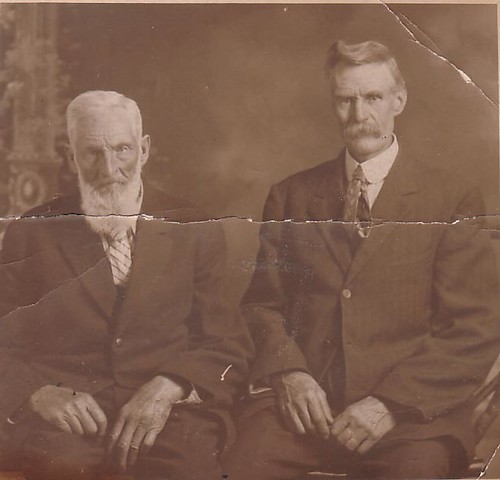
As it turns out, James Thomas Becraft (born in 1827 in Booneville, Kentucky) traveled overland to Plumas County, California in 1853 with his wife Rebecca. He worked alternately as a gold miner and logger until 1873, when he became a farmer. Rebecca died in 1878, and by 1900, James T. had moved north to Oregon, then on to Sedro-Woolley, Washington by 1910 to live with his son Charles Edward, until James T. died the next year.
My wife and I visit friends in Sedro-Woolley fairly regularly, so I did a bit more research before a trip up there last week and confirmed that James T. Becraft was indeed buried in Sedro-Woolley. My friend Josh is a bit of a historian himself, so he and I drove to the Union Cemetery in Sedro-Woolley this past Saturday and scoured alternate rows for my relatives. There are seventeen Becrafts buried in Sedro-Woolley, and we had found nearly all of them — but not my direct ancestor James Thomas — when we called it a day and drove off.
As Josh sped up, I noticed what looked like a map on a sign by the side of the road, and I called “Wait!” He turned the car around and we began looking through the section of the cemetery we hadn’t noticed before, where Oddfellows were buried. Within a few minutes, we had found Great-Great-Great-Grandpa Becraft.

There’s a sense of place that emerges from the overwhelming cultural significance of the archaic structure one stands within — Newgrange or Westminster Abbey — and the sense of connectedness that place brings you as a member of the broader human species. But to stand before the grave of my forefather is another sense of place entirely and a very different kind of connectedness.
To the list of places where my roots spread beneath the ground, I now add Sedro-Woolley, one of my many homes.
-
Industrial design of the Holocene
Last year, I mused about the ergonomics of Paleolithic tools. More recently, artists Ami Drach and Dov Ganchrow have combined Paleolithic design with modern handles for an incredibly beautiful mashup of modern and ancient aesthetics.

Full write-up on designboom, via MAKE.
-
Watchmen & V for Vendetta: Exploring challenging ideas through complex characters
On
the recommendation of a friend, I began my comic book education with Watchmen
Starting with the first words and images, writer Alan Moore and artist Dave Gibbons subvert the very genre in which they work. The style of Gibbons’ art is consistent with what I remember from “regular” comic books (something I found mildly distracting at first), but both the subject matter and the composition — within and between panels — reward careful scrutiny, revealing patterns, echoes, and reverberations throughout the book. I expect a second and third reading to reward me with even more.
Watchmen in particular reveals a structural complexity I would never have expected from a comic book, interleaving a disturbing pirate tale throughout the modern-day story — a counterpoint to the rhythm of the primary plot. The narration within the pirate story provides ironic commentary, while its own plot and imagery build into a symbolic backdrop against which the present-day “real-life” story unfolds. Rorschach’s journal provides the bulk of the narration, and over the course of the book one begins to question whether he’s really a reliable narrator.
I say “modern-day story,” but Watchmen is set during the Cold War, while V for Vendetta is set in a post-apocalyptic England at the turn of the millennium, 15 or more years in the future from the time of the graphic novel’s writing. Both stories are overtly political, and a product of their times. As a child of the 70’s and 80’s, I remember the apocalyptic dread that permeated adult conversations, and how that dread trickled down (like some sort of horrific Reaganomics) to my friends and me.
We speculated about what would happen if the Soviets attacked. Living in Japan surrounded by American military bases, with recent memories of the Hiroshima Peace Museum to fuel our imaginations, there was no doubt in our young minds that we would be vaporized long before ICBMs ever reached the distant United States. I’m sure I’m missing allusions and references to traditional American comic books, but it’s hard for me to imagine a teenager today understanding the geopolitical context that gave birth to both of these graphic novels.
 Unlike the one-dimensional heroes of my cousins’ comics, Moore’s characters demonstrate a complexity more typical of Steinbeck or Hemingway. I don’t use that comparison lightly. There is a darkness in the souls of the Comedian and Rorschach born of cynicism and sadism — these men are psychopaths forged in the fires of a broken society, nothing like the classic heroes Spider-Man or Superman.
As strange as this may sound to those who don’t read comic books and graphic novels, Moore’s characters feel like real people. Nite Owl is an aging, overweight “billionaire playboy” (echoes of Batman) who struggles with the boredom of forced retirement. Silk Spectre’s origin story is horrifying on multiple levels — no radioactive spiders here!
The omnipotent Doctor Manhattan — the only character with traditional superpowers — looms in stark contrast to the other characters, a foil that serves to highlight both the flaws and values of their humanity.
Similarly, the power of “V” lies in his distance from the norms of human behavior. The fascist antagonists aren’t wrong that V is a terrorist — he blows up Parliament and various other London landmarks, and murders numerous political elites over the course of the book. He abandons and then tortures his protege. But in doing so, he forces Evey to shed everything in her spirit but her powerful core, empowering her to carry on the revolution after V’s inevitable death. V frees Evey as an individual and sets in motion the liberation of England. Is V evil? By any definition of “civilized” conduct, yes. Nevertheless, V forces the reader to confront what he or she would be willing to do to stand up for the freedom that we all take for granted today.
What I appreciate so deeply about both Watchmen and V for Vendetta is what I’ve grown to love in the science fiction of Robert Heinlein. Alan Moore presents characters and ideas that I don’t necessarily like, that I can’t necessarily relate to, that I frequently disagree with vehemently, but that force me to think and to reflect. Through Watchmen, I’m forced to take the idea of vigilante justice seriously, and to question the moral sacrifices I would be willing to make for the greater good. Through V for Vendetta, I’m forced to consider my own pacifist political views within the context of the tension between fascism and anarchism.
Unfortunately, this tension is all too real and continues to have a lingering effect on my city of Seattle, as well as the United States and the rest of the world in the aftermath of the terrorist attacks on 9/11. What makes both Watchmen and V for Vendetta timeless literary classics is the way Moore explores timeless questions of right and wrong within a believably human context.
You don’t have to agree with the decisions that Nite Owl and Silk Spectre make at the end of Watchmen (or how Rorschach describes the unfolding story), nor with what V and Evey do in V for Vendetta, but you do have to think. And that’s what really matters.


-
Subscribe
Subscribed
Have a WordPress.com account? Log in now.

