-
Mousterian Dawn
Poetry deserves a cheesy science-fiction chaser. An original sci-fi short story follows…
Doris McDonald lived in a rent-controlled apartment on the eighty-fifth floor of a building overlooking the Mare Imbrium. After retiring from the observatory with a government pension, she could live comfortably, well compensated for the fact that her body – weakened after decades serving science up here in the sky – could never go home. She chose to live frugally, however, her only luxury a pair of GeneCorp® NeanderClones™ shipped up from below.
She could hear the female, Polly, humming as she washed up after serving dinner. The tune was in a scale unlike anything in the complete library of world music built into the apartment. Polly’s singing always made the hair stand up on the back of Doris’ neck.
It’s not that she was afraid of her ‘Clones – attacks on their Modern masters were a thing of the past, ever since the company had begun neutering the males before delivery. In moments of real panic, shock collars artfully disguised as Celtic torques could be activated at the touch of a button. The anthropological anachronism annoyed only scholars of ancient history. NeanderClone owners had nothing to fear.
Read the complete story after the jump! Keep reading…
-
Space Shuttle Endeavour STS-134 ascent highlights
With or without a musical soundtrack, there’s something inherently stirring about watching a spacecraft lift off into orbit.
In this case, it’s the very last launch for Space Shuttle Endeavour. Thanks to all the cameras designed to ensure the Columbia tragedy never recurs, we can watch the launch from just about every angle.
-
Renovating Building 112
Workmen are remodeling our office.
They gather by the dozen
to eat breakfast – sock caps low
over foreheads, face masks slung
around necks. One tells a joke
I can’t hear, and their laughter
rumbles over plastic chairs, cash registers,
condiments, the salad bar.
From my corner booth I can see
cranes that tower over evergreens
marked with bright pink ribbons
for the chainsaw. I look back
and they’re gone – nothing left
but napkins stacked neatly
on the center of the table.I wrote this poem almost exactly four years ago, when I frequently stopped for coffee or breakfast in a Microsoft building between my bus stop and my own building. My product group has moved to another satellite campus since then, but I was back in Building 112 this morning for a meeting and overheard a team of corporate movers swapping stories about their accident-prone supervisor. I finished my coffee, looked up, and they were gone. I immediately thought of this poem.
I owe the poem’s current form and other improvements to feedback from David Wagoner while he was the Poet in Residence at Richard Hugo House.
-
JFK on the key to our future on earth
50 years ago today, John F. Kennedy spoke before congress and set a remarkable vision for the nation with the famous words, “This nation should commit itself to achieving the goal, before this decade is out, of landing a man on the moon and returning him safely to the Earth.”
(Space.com has the full speech.)
Side note: $30 million for nuclear rockets? Interesting to see which aspects of Kennedy’s vision panned out — like the moon landing — and which didn’t.
-
Lessons from the Burke Museum of Natural History & Culture
With a list of favorite museums that spans the British Museum, MFA in Boston, and Cairo Museum, it hardly seems fair for me to hold museums here in Seattle to the same standards. After all, Seattle isn’t a national capitol like Dublin, nor a major metropolis like New York City. Nevertheless, it’s hard for me to set aside certain expectations I’ve developed over the decades for “what a museum should be.”
 So far, the only museum in Seattle that hasn’t disappointed on some level is the Burke Museum of Natural History and Culture, on the University of Washington campus. The Burke isn’t perfect, but there’s a lot to learn among its exhibits.
We arrived shortly after the museum opened at 10:00 and parked for free ($9.50 Mon-Sat) behind the museum. Even the Burke’s first impression is more “museum-like” than MOHAI or SAM, with large fossils lining the walkway and replicas of Northwest Coast totem poles (19th-century originals long-since decayed or rightfully returned to their tribal owners) standing amid the nearby trees. My wife was enchanted by the well-tended landscaping, and it was all I could do to drag her indoors.
In the museum foyer, a long glass case contains the museum’s most treasured artifacts and specimens. They were all lovely, but the only one that left a lasting impression was the skull of an orangutan donated by the Woodland Park Zoo, which sort of just made me sad thinking about the orang who must have died in the zoo and ended up here (don’t get me wrong; I do think zoos have an important role to play in conservation and education). We pressed on.
I was most interested in the museum’s collections of Washington State archaeological artifacts, and assumed that they would be displayed in the “cultural exhibits” that the man behind the front desk (with an impressive mustache) pointed us to downstairs.
The “Pacific Voices” exhibit appears to suggest that there is some sort of unifying culture that spans the Pacific Rim, from the Northwest Coast Indians to the distant Maori, Lao, Koreans, and other peoples who share access to this ocean. Some ethnologists have begun making tentative connections between Native American tribes here in the Pacific Northwest and the Ainu of Hokkaido, but an overarching Pacific culture seems as anthropologically unsound as a single Asian culture.
Taken individually, most of the exhibits in “Pacific Voices” were fascinating — a combination of intriguing artifacts from all over the Pacific and excellent contemporary art with a few models thrown in for interpretive purposes, but several of the sections lacked any meaningful artifacts (the Korean mannequins having a wedding and the abandoned Chinese New Year meal), and it was hard to buy the unifying theme beyond a common body of water. Perhaps I missed a placard clarifying the nuance the curators intended.
As it turns out, what I was really looking for in the museum was all upstairs, in the “Life and Times of Washington State” exhibit. Starting in the Cambrian and Ordovician with trilobites and crinoids, the exhibit walks visitors through the natural and early human history of Washington State, ending with the paleontology and archaeology of the state when it was first populated by the Clovis people.
Along the way, there’s a digression for dinosaurs — required to attract the critical museum demographic of 9-year-olds — even though Washington was mostly underwater at the time. In addition to the usual casts one might expect at a small museum, the Burke has an excellent mesosaurus plate from Brazil (Mesosaurus tenuidens) and complete, articulated mosasaur (Platecarpus tympaniticus).

Perhaps most exciting is an as-yet-unpublished holotype fossil of a new genus of early baleen whale. Other notable fossils include gorgeous crabs from the Lincoln Creek Formation in Grays Harbor County and “stone rose” from Republic.
But it’s ultimately the material culture of my fellow humans that I look for in natural history museums — along with the flora and fauna in their environments — and I wasn’t disappointed. Rounding a corner, a complete mastodon skeleton looms over a low ramp. On the left, Ice Age fossils from mammoth tusks to bison horns. An unexpected find at the Burke: The skeleton of a giant ground sloth excavated while building Sea-Tac Airport in 1961. On the right, a display case contains the East Wenatchee Clovis Cache.
Between sentences as I type this, I’m feeling the weight of my newly rediscovered paleolithic blades in my left hand. On the opposite arm of the chair, I’ve lined up my neolithic blades.
The contrast between the people who made the crude paleolithic blades and the near-modern (on evolutionary time scales) first people of the Americas couldn’t be more clear. (Update: See why my assessment of paleolithic tools as “crude” may be wrong: “Industrial design of the paleolithic“.)
And there’s a clear connection between the smooth, clean lines of my neolithic blades from ‘Ain Ghazhal and these stunning Clovis blades from Wenatchee, Washington. Both the blades and their very presence in America represent the inevitable progress we make as a species.
This brings us full circle to the “Pacific Voices” exhibit I criticized earlier.
Even if human culture of the last thousand years can’t be summarized so simplistically with an idea like “Pacific Rim culture,” there is deep truth to the idea that we really are all one people, with shared history and a shared future. The neolithic blades in my right hand and the Clovis blades at the Burke are proof of our shared history. The diversity on display in the “Pacific Voices” exhibit reflects how far we’ve come as a species since then, but it also reflects the deep divisions between us — especially as illustrated by the religious practices Burke curators have chosen to focus on.
As we look to our future, perhaps there are more lessons about our similarities to be learned from the people of Clovis and ‘Ain Ghazal than from “Pacific Voices.”
-
Gravity-assisted Beethoven in Japanese woods
Japanese telecom NTT Docomo released this gorgeous advertisement for a new, wood-encased mobile phone (which itself is gorgeous). Watch and be amazed.
Via Boing Boing.
-
Lost tools of the paleolithic
The summer of ’94, I spent my days excavating a 5×5 meter square of Tall al-‘Umayri near Amman, Jordan. As with so much of Near Eastern archaeology, the dig was mostly funded and staffed by Christian colleges in America, with a goal to reach the layers most likely to contain artifacts of interest to believers. I can’t fault the completeness or rigor of the science applied to the process along the way, but it always seemed like there was so much more to learn than the Late Iron II strata could offer — from the late Roman mikveh near the surface to the neolithic burials excavated without fanfare on the fringes of the project.
I was drawn inexorably to that deeper past, far beyond the 6,000-year timeline to which so many believers back home limited their thinking. There in the field, even theology professors set aside their biblical literalism to work and talk within the context of the facts evident all around us.

Neolithic blade from ‘Ain Ghazal, a “mere” 8,500-9,250 years oldDrawn by stories of undiscovered sites nearby, I walked in the cool evenings through the fallow fields surrounding the school for Palestinian girls where the project was headquartered. I found myself stepping across the surface of a world much, much older than Moses, Abraham, Noah, or Adam and Eve. Chipped stones lay scattered across furrows of barley stubble ploughed under at the end of the last season, and I filled my pockets with chunks of tan stone streaked with oranges and browns.
I’d corner one of the archaeologists and seek an impromptu lithic analysis. Laid out on a table or the side of an unmade bunk bed, I’d wait with baited breath for each pronouncement of “paleolithic scraper” or “mesolithic spearpoint,” disappointed with the overwhelmingly common “Sorry, that’s most likely just a rock.”
Surface archaeology — walking surveys of the landscape — tells us what lies beneath, where to dig someday when there’s time and money, but often little more. Recovered from the churned soil of a modern field in a part of the world where human history goes back far older than 50,000 years ago, it’s shocking to learn that there’s little value in these little hunks of rock — an easy approval for me to take them home by the nice man from the Department of Antiquities.
And so, these tools knapped from chert by people thirty, forty, fifty thousand years ago became some of my most treasured possessions. I could hold in my hand something made when ice sheets still covered much of Europe and humans still hadn’t entered the Americas — a time even before artists put aurochs, woolly mammoth, and herds of prancing horses on the walls of Lascaux and Chauvet. I felt a real connection with the men and women who lived all those years ago, a deeper connection than with any character from an ancient storybook.
In a cross-country move between Boston and Seattle, carefully packed to ensure no new chips flaked away, I lost track of my priceless artifacts. In a sense, it’s funny: Excavated by the larger blades of modern, mechanical ploughs, they emerged into the sunlight after tens of thousands of years only to be reburied in a box of miscellaneous office junk (a fate shared by many artifacts in museum vaults).
So I search for them all over again. Every so often, I’ll take down a box left packed for more than a decade and remove a few layers — books of 33-cent stamps, half-used note pads, and stacks of bills paid long ago. Someday, I’ll find them buried at the bottom of a box, pull them out, feel the smooth stone and hear them clink against each other. Someday, I’ll excavate these lost tools once again.
-
Einstein on curiosity
“The important thing is not to stop questioning. Curiosity has its own reason for existing. One cannot help but be in awe when he contemplates the mysteries of eternity, of life, of the marvelous structure of reality. It is enough if one tries merely to comprehend a little of this mystery every day. Never lose a holy curiosity.” – Albert Einstein

Contemplating the marvelous structure of reality, underground in New Zealand -
Chauvet in 3D – Cave of Forgotten Dreams
My sense of awe and wonder is most often sparked by a newfound understanding of my place in the universe, a feeling Michael Shermer calls “deep and sacred science.” I’ve felt it listening to “The Messiah” in Westminster Abbey next to Handel’s tomb, unearthing the hearth of a 3,200-year-old house, or climbing hundreds of steps through mist-soaked cedars to a neglected Shinto shrine.
For me, the sense is strongest when I feel a connection to my fellow humans, both those with whom I share the planet today and all those who came before. It’s one reason I’m so fascinated by archaeology — the deeper the past, the deeper my awe and wonder.
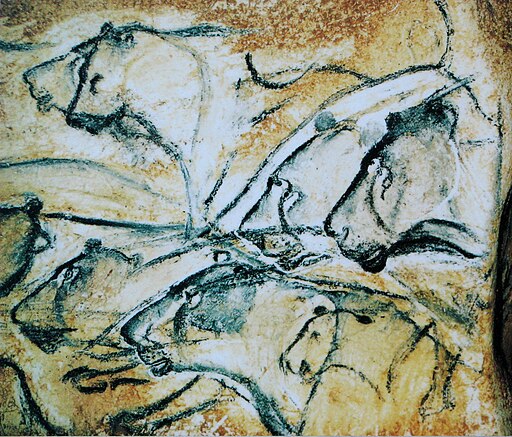
The Chauvet cave in southeast France was discovered in 1994, and contains the world’s oldest examples of cave art. Artists painted and engraved horses, aurochs, rhinos, mammoths, lions, leopards, and many other Ice Age animals on the cave walls 32,000-30,000 years ago (in the Aurignacian) and again 27,000-26,000 years ago (Gravettian). Just as in Lascaux, the artists used the natural contours of the cave to accentuate their artwork — the jaw muscles of a horse, the humped shoulder of a bison.
You can’t see these shapes in photographs, and unlike Lascaux there is (as yet) no full-scale modern reproduction to satisfy those of us who won’t ever step through that locked door and enter this ancient cathedral.
This is where Werner Herzog‘s new documentary “Cave of Forgotten Dreams” proves invaluable.
Herzog’s film captures the pristine cave art like no photograph or even 2D movie can. Herzog also includes touching moments of modern humanity, like the experimental archaeologist who plays “The Star Spangled Banner” on a reproduction Ice Age flute, his colleague who dreamed of lions after spending five days in the cave, and the master perfumer who crawls through the brush sniffing for the scent of undiscovered caves.
My only criticism is reserved for the last two minutes of the film, during which Herzog narrates a well-meaning “postscript” that attempts to connect modernity with antiquity via an analogy featuring albino alligators warmed by nuclear power plant effluvium. (No, I didn’t get it either.) After the final cave sequence, it would have been a postscript best left unread.
But when the filmmaker lets light, dark, the cave, and the artists themselves work their ancient magic, the experience is positively numinous.
-
Naps
I didn’t take naps. I don’t think I’d ever taken naps.
Father had church business with church elders next door, and he left me to play with the kindergarteners. At first, they stared at me, even though I wore the same clothes they all wore — blue shorts, white shirt, and round red hat.
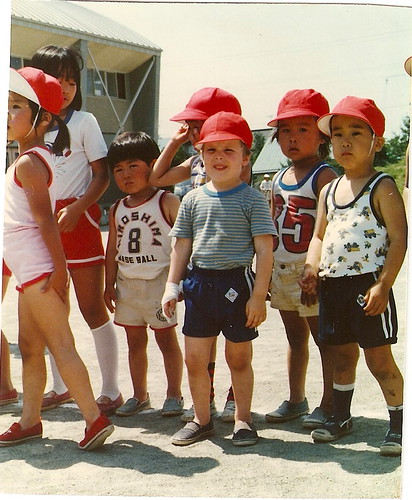
The oldest boy called me a gaijin and then laughed.
“I was born in Tokyo,” I corrected him, “I’m a Child of Edo, you Son of the Soil.” Some of the girls laughed.
I played on the swing. The toes of all the other children had scooped the dry sand from under the seats, leaving furrows beneath my feet. At the top of each arc, I could see our blue Subaru over the concrete wall, parked in the church driveway. I played hopscotch with the girls who were nice earlier. I let them win.
A bell rang and we all went inside to sing “Twinkle Twinkle Little Star.” When we sang “The Elephant Song,” I waved my arm from my face just like everyone else. The others were learning to count, but I already knew all ten of them so I was bored.
A lady in glasses and a green dress brought rice balls wrapped in seaweed and we each took one. I loved the saltiness of the black seaweed and the tang of the pickled plum in the center of the rice. The taste reminded me of staying over at Aunt Kiwako’s.
The teacher and the lady in green took mats from a closet and laid them on the floor. The others lay down quietly, some on their sides, some on their backs, some on their stomachs with an arm cradling their face. I told them I didn’t take naps but they didn’t care. They told me to lie down quietly and close my eyes.
I watched the red and green swirls behind my eyelids. I practiced counting to ten. I thought about the day before, when mother and I went to the park to meet father after work. I jumped over ditches and didn’t fall in. My favorite slide snaked down the hill, and I raced mother, me sliding in my corduroys, she running in her plaid skirt. I always won. Father came swinging his black briefcase.
When I woke up, we were on the highway home. I opened my eyes and pretended I hadn’t been sleeping. Some old ladies were planting shoots of rice in a field that we passed. They were probably singing.
Father said, “Did you sleep well? You must have had a lot of fun with all your new friends.”
“I wasn’t sleeping,” I said. “I don’t take naps. And they weren’t my friends.”
Rain began to streak the windows. Father flicked a knob and the windshield wipers started playing sumo. The one on the left always won. I turned to watch the power lines dip down, and then up, and then down again.


.jpg)
-
Subscribe
Subscribed
Already have a WordPress.com account? Log in now.
 Andrew-Becraft.com